25 декабря 2018 г.

M100: A Grand Design Spiral Galaxy #119 Majestic on a truly…

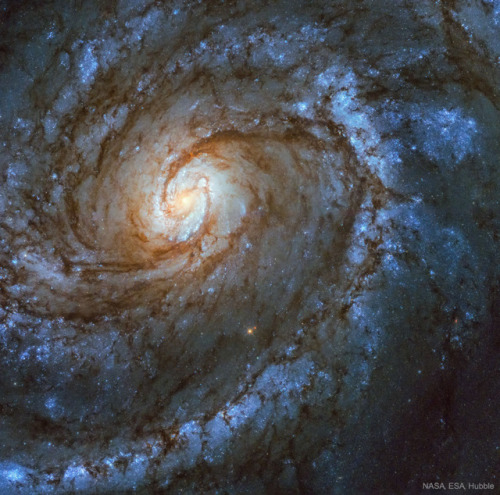
M100: A Grand Design Spiral Galaxy #119 Majestic on a truly cosmic scale, M100 is appropriately known as a grand design spiral galaxy. It is a large galaxy of over 100 billion stars with well-defined spiral arms that is similar to our own Milky Way Galaxy. One of the brightest members of the Virgo Cluster of galaxies, M100 (alias NGC 4321) is 56 million light-years distant toward the constellation of Berenice’s Hair (Coma Berenices). This Hubble Space Telescope image of M100 was taken recently with the Wide Field Camera 3 and accentuates bright blue star clusters and intricate winding dust lanes which are hallmarks of this class of galaxies. Studies of variable stars in M100 have played an important role in determining the size and age of the Universe. via NASA https://apod.nasa.gov/apod/ap181225.html


from WordPress https://vladislavkarelin.wordpress.com/2018/12/25/m100-a-grand-design-spiral-galaxy-119-majestic-on-a-truly/


https://66.media.tumblr.com/44b2a1a2e5a9696c4abbf6500dfadbb4/tumblr_pka34aIgF01xorz76o1_500.jpg

12 декабря 2018 г.

M43: Orion Falls #119 Is there a waterfall in Orion? No, but…

M43: Orion Falls #119 Is there a waterfall in Orion? No, but some of the dust in M43 appears similar to a waterfall on Earth. M43, part of the Orion Molecular Cloud Complex, is the often imaged but rarely mentioned neighbor of the more famous M42. M42, which includes many bright stars from the Trapezium cluster, lies above the featured scene. M43 is itself a star forming region and although laced with filaments of dark dust, is composed mostly of glowing hydrogen. The entire Orion field, located about 1600 light years away, is inundated with many intricate and picturesque filaments of dust. Opaque to visible light, dark dust is created in the outer atmosphere of massive cool stars and expelled by a strong outer wind of protons and electrons. via NASA https://apod.nasa.gov/apod/ap181212.html


from WordPress https://vladislavkarelin.wordpress.com/2018/12/12/m43-orion-falls-119-is-there-a-waterfall-in-orion-no-but/


https://66.media.tumblr.com/7702add78c96a3ca63bad689f7b7de6b/tumblr_pjm0gq0KnR1xorz76o1_500.jpg

9 декабря 2018 г.

Aurora Shimmer, Meteor Flash #119 Some night skies are serene…

Aurora Shimmer, Meteor Flash #119 Some night skies are serene and passive – others shimmer and flash. The later, in the form of auroras and meteors, haunted skies over the island of Kvaløya, near Tromsø Norway on 2009 December 13. This 30 second long exposure records a shimmering auroral glow gently lighting the wintery coastal scene. A study in contrasts, the image also captures the sudden flash of a fireball meteor from the excellent Geminid meteor shower of 2009. Streaking past familiar stars in the handle of the Big Dipper, the trail points back toward the constellation Gemini, off the top of the view. Both auroras and meteors occur in Earth’s upper atmosphere at altitudes of 100 kilometers or so, but aurora caused by energetic charged particles from the magnetosphere, while meteors are trails of cosmic dust. Nine years after this photograph was taken, toward the end of this week, the yearly 2018 Geminids meteor shower will peak again, although this time their flashes will compete with the din of a half-lit first-quarter moon during the first half of the night. via NASA https://apod.nasa.gov/apod/ap181209.html


from WordPress https://vladislavkarelin.wordpress.com/2018/12/09/aurora-shimmer-meteor-flash-119-some-night-skies-are-serene/


https://66.media.tumblr.com/22abb696dc880f2dd2378477d8d1da2d/tumblr_pjgggc1udl1xorz76o1_500.jpg

7 декабря 2018 г.

December s Comet Wirtanen #119 Coming close in mid-December,…

December s Comet Wirtanen #119 Coming close in mid-December, Comet 46P Wirtanen hangs in this starry sky over the bell tower of a Romanesque church. In the constructed vertical panorama, a series of digital exposures capture its greenish coma on December 3 from Sant Llorenc de la Muga, Girona, Catalonia, Spain, planet Earth. With an orbital period that is now about 5.4 years, the periodic comet’s perihelion, its closest approach, to the Sun will be on December 12. On December 16 it will be closest to Earth, passing at a distance of about 11.6 million kilometers or 39 light-seconds. That’s close for a comet, a mere 30 times the Earth-Moon distance. A good binocular target for comet watchers, Wirtanen could be visible to the unaided eye from a dark sky site. To spot it after dusk on December 16, look close on the sky to the Pleiades star cluster in Taurus. via NASA https://apod.nasa.gov/apod/ap181207.html


from WordPress https://vladislavkarelin.wordpress.com/2018/12/07/december-s-comet-wirtanen-119-coming-close-in-mid-december/


https://66.media.tumblr.com/5c348b46ef5f8112d5adc8240f84d366/tumblr_pjcr4s5gDl1xorz76o1_500.jpg

4 декабря 2018 г.

Rocket Launch between Mountains #119 What’s happening…

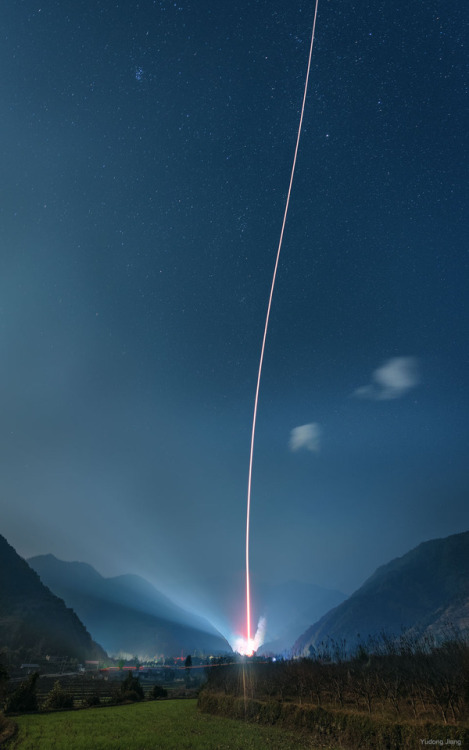
Rocket Launch between Mountains #119 What’s happening between those mountains? A rocket is being launched to space. Specifically, a Long March 3B Carrier Rocket was launched from Xichang Satellite Launch Center in Sichuan Province in China about two week ago. The rocket lifted two navigation satellites to about 2,000 kilometers above the Earth’s surface, well above the orbit of the International Space Station, but well below the orbit of geostationary satellites. China’s Chang’e 3 mission that landed the robotic Yutu rover on the Moon was launched from Xichang in 2013. The featured image was taken about 10 kilometers from the launch site and is actually a composite of nine exposures, including a separate background image. via NASA https://apod.nasa.gov/apod/ap181204.html


from WordPress https://vladislavkarelin.wordpress.com/2018/12/04/rocket-launch-between-mountains-119-whats-happening/


https://66.media.tumblr.com/61186cb07fe34480ddbea51f8c7f7cc5/tumblr_pj774n36SM1xorz76o1_500.jpg

3 декабря 2018 г.

Spiraling Supermassive Black Holes #119 Do black holes glow…

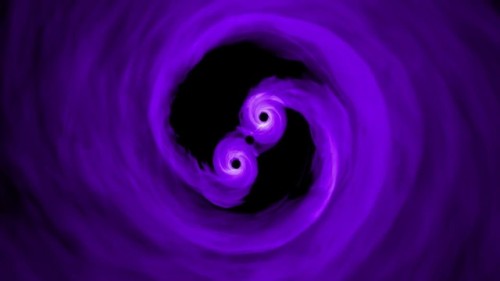
Spiraling Supermassive Black Holes #119 Do black holes glow when they collide? When merging, co-orbiting black holes are sure to emit a burst of unusual gravitational radiation, but will they emit light, well before that, if they are surrounded by gas? To help find out, astrophysicists created a sophisticated computer simulation. The simulation and featured resulting video accurately depicts two spiraling supermassive black holes, including the effects of Einstein’s general relativity on the surrounding gas and light. The video first shows the system from the top, and later from the side where unusual gravitational lens distortions are more prominent. Numerical results indicate that gravitational and magnetic forces should energize the gas to emit high-energy light from the ultraviolet to the X-ray. The emission of such light may enable humanity to detect and study supermassive black hole pairs well before they spiral together. via NASA https://apod.nasa.gov/apod/ap181203.html


from WordPress https://vladislavkarelin.wordpress.com/2018/12/03/spiraling-supermassive-black-holes-119-do-black-holes-glow/


https://66.media.tumblr.com/0bb779ffbd8c2d3d80be8a09723c4c32/tumblr_pj5cgejluh1xorz76o1_500.jpg