2 декабря 2019 г.

Mercury Crosses a Quiet Sun #119 What’s that black dot…

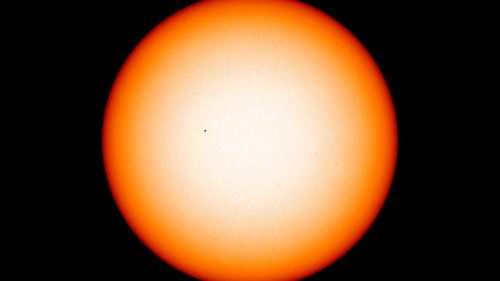
Mercury Crosses a Quiet Sun #119 What’s that black dot crossing the Sun? The planet Mercury. Mercury usually passes over or under the Sun, as seen from Earth, but last month the Solar System’s innermost planet appeared to go just about straight across the middle. Although witnessed by planet admirers across the globe, a particularly clear view was captured by the Solar Dynamics Observatory (SDO) in Earth orbit. The featured video was captured by the SDO’s HMI instrument in a broad range of visible light, and compresses the 5 ½ hour transit into about 13 seconds. The background Sun was unusually quiet – even for being near Solar Minimum – and showed no sunspots. The next solar transit by Mercury will occur in 2032. via NASA https://apod.nasa.gov/apod/ap191202.html


from WordPress https://vladislavkarelin.wordpress.com/2019/12/02/mercury-crosses-a-quiet-sun-119-whats-that-black-dot/


https://66.media.tumblr.com/5c6b3027ad25de37464b0482da78a127/52fa4b08066be350-62/s500x750/5c905258a71aa29aec007c6ad471ed80723a07cf.jpg

29 ноября 2019 г.

Galileo s Europa Remastered #119 Looping through the Jovian…

Galileo s Europa Remastered #119 Looping through the Jovian system in the late 1990s, the Galileo spacecraft recorded stunning views of Europa and uncovered evidence that the moon’s icy surface likely hides a deep, global ocean. Galileo’s Europa image data has been remastered here, using improved new calibrations to produce a color image approximating what the human eye might see. Europa’s long curving fractures hint at the subsurface liquid water. The tidal flexing the large moon experiences in its elliptical orbit around Jupiter supplies the energy to keep the ocean liquid. But more tantalizing is the possibility that even in the absence of sunlight that process could also supply the energy to support life, making Europa one of the best places to look for life beyond Earth. What kind of life could thrive in a deep, dark, subsurface ocean? Consider planet Earth’s own extreme shrimp. via NASA https://apod.nasa.gov/apod/ap191129.html


from WordPress https://vladislavkarelin.wordpress.com/2019/11/29/galileo-s-europa-remastered-119-looping-through-the-jovian/


https://66.media.tumblr.com/00c72a2eff83ed121eec0685a9cd8383/7bc677a7d976a17c-ee/s500x750/9ddd8387e4c8378d497ec9f60f13d16576d6c249.jpg
25 октября 2019 г.

The Ghosts of Cassiopeia #119 These bright rims and flowing…

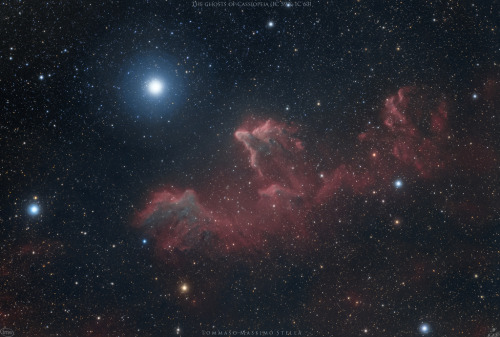
The Ghosts of Cassiopeia #119 These bright rims and flowing shapes look ghostly on a cosmic scale. A telescopic view toward the constellation Cassiopeia, the colorful skyscape features swept-back, comet-shaped clouds IC 59 (left) and IC 63. About 600 light-years distant, the clouds aren’t actually ghosts. They are slowly disappearing though, under the influence of energetic radiation from hot,luminous star gamma Cas. Gamma Cas is physically located only 3 to 4 light-years from the nebulae, the bright star just above and left in the frame. Slightly closer to gamma Cas, IC 63 is dominated by red H-alpha light emitted as hydrogen atoms ionized by the star’s ultraviolet radiation recombine with electrons. Farther from the star, IC 59 shows proportionally less H-alpha emission but more of the characteristic blue tint of dust reflected star light. The field of view spans over 1 degree or 10 light-years at the estimated distance of gamma Cas and friends. via NASA https://apod.nasa.gov/apod/ap191025.html


from WordPress https://vladislavkarelin.wordpress.com/2019/10/25/the-ghosts-of-cassiopeia-119-these-bright-rims-and-flowing/


https://66.media.tumblr.com/706189ef3f196169eb7c23b68e05ea4c/a581365a3e243928-7c/s500x750/24ff2676861493dbd6f91e2d664265a10f701273.jpg

5 сентября 2019 г.

The Large Cloud of Magellan #119 The 16th century Portuguese…

The Large Cloud of Magellan #119 The 16th century Portuguese navigator Ferdinand Magellan and his crew had plenty of time to study the southern sky during the first circumnavigation of planet Earth. As a result, two fuzzy cloud-like objects easily visible to southern hemisphere skygazers are known as the Clouds of Magellan, now understood to be satellite galaxies of our much larger, spiral Milky Way galaxy. About 160,000 light-years distant in the constellation Dorado, the Large Magellanic Cloud (LMC) is seen here in a remarkably deep, colorful, image. Spanning about 15,000 light-years or so, it is the most massive of the Milky Way’s satellite galaxies and is the home of the closest supernova in modern times, SN 1987A. The prominent patch below center is 30 Doradus, also known as the magnificent Tarantula Nebula, a giant star-forming region about 1,000 light-years across. via NASA https://apod.nasa.gov/apod/ap190905.html


from WordPress https://vladislavkarelin.wordpress.com/2019/09/05/the-large-cloud-of-magellan-119-the-16th-century-portuguese/


https://66.media.tumblr.com/0bc73e81f6092cd1254c1de52a0e761a/tumblr_pxcdup65ae1xorz76o1_500.jpg

30 июня 2019 г.

Virtual Flight over Asteroid Vesta #119 What would it be like…

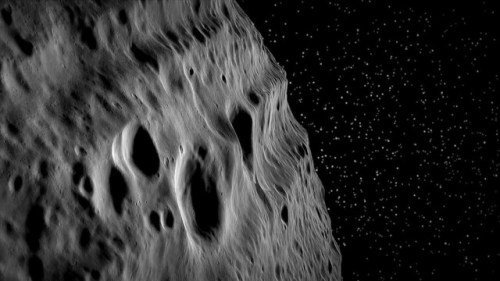
Virtual Flight over Asteroid Vesta #119 What would it be like to fly over the asteroid Vesta? Animators from the German Aerospace Center took actual images and height data from NASA’s Dawn mission when it visited asteroid Vesta a few years ago and generated a virtual movie. The featured video begins with a sequence above Divalia Fossa, an unusual pair of troughs running parallel over heavily cratered terrain. Next, the virtual spaceship explores Vesta’s 60-km Marcia Crater, showing numerous vivid details. Last, Dawn images were digitally recast with exaggerated height to better reveal Vesta’s 5-km high mountain Aricia Tholus. The second largest object in the Solar System’s asteroid belt, Vesta is the brightest asteroid visible from Earth and can be found with binoculars. Using Vesta Trek, you can explore all over Vesta yourself. via NASA https://apod.nasa.gov/apod/ap190630.html


from WordPress https://vladislavkarelin.wordpress.com/2019/06/30/virtual-flight-over-asteroid-vesta-119-what-would-it-be-like/


https://66.media.tumblr.com/d799cff7375d07760e61e0d4103438ee/tumblr_ptwb0m1ckP1xorz76o1_500.jpg

11 июня 2019 г.

The Cave Nebula in Infrared from Spitzer #119 What’s…

The Cave Nebula in Infrared from Spitzer #119 What’s happening in and around the Cave Nebula? To help find out, NASA’s orbiting Spitzer Space Telescope looked into this optically-dark star-forming region in four colors of infrared light. The Cave Nebula, cataloged as Sh2-155, is quite bright in infrared, revealing details not only of internal pillars of gas and dust, but of the illuminating star cluster too — all near the top of the image. The red glow around the Cave’s entrance is created by dust heated by bright young stars. To the right is Cepheus B, a star cluster that formed previously from the same cloud of gas and dust. Other interesting stars of Cepheus come to light in infrared as well, including those illuminating an even younger nebula toward the image bottom, and a runaway star pushing a bow shock, tinged in red near the image center. This region spans about 50 light years and lies about 2,500 light years toward the constellation of the King of Aethiopia (Cepheus). via NASA https://apod.nasa.gov/apod/ap190611.html


from WordPress https://vladislavkarelin.wordpress.com/2019/06/11/the-cave-nebula-in-infrared-from-spitzer-119-whats/


https://66.media.tumblr.com/57e250c5e36fc2787c0ac13ce77446b2/tumblr_psx4de0KCF1xorz76o1_500.jpg

21 мая 2019 г.

From Day Into Night on the International Space Station #116 A…

From Day Into Night on the International Space Station #116 A couple times a year, the International Space Station orbit happens to align over the day/night shadow line on Earth. via NASA http://www.nasa.gov/image-feature/from-day-into-night-on-the-international-space-station


from WordPress https://vladislavkarelin.wordpress.com/2019/05/21/from-day-into-night-on-the-international-space-station-116-a/


https://66.media.tumblr.com/9b4cca1cf47ff1e0754db34accde174e/tumblr_pruygafjWX1xorz76o1_500.jpg

11 мая 2019 г.

Milky Way, Launch, and Landing #119 The Milky Way doesn’t…

Milky Way, Launch, and Landing #119 The Milky Way doesn’t look quite this colorful and bright to the eye, but a rocket launch does. So a separate deep exposure with a sensitive digital camera was used in this composite skyscape to bring out our galaxy’s central crowded starfields and cosmic dust clouds. In the scene from Merritt Island National Wildlife Refuge, a nine minute long exposure begun about 20 minutes after the Miky Way image recorded a rocket launch and landing. The Falcon 9 rocket, named for the Millennium Falcon of Star Wars fame, appropriately launched a Dragon resupply ship to the International Space Station in the early morning hours of May the 4th. The plume and flare at the peak of the launch arc mark the rocket’s first stage boost back burn. Two shorter diagonal streaks are the rocket engines bringing the Falcon 9 stage back to an offshore landing on autonomous drone ship Of course I Still Love You. via NASA https://apod.nasa.gov/apod/ap190511.html


from WordPress https://vladislavkarelin.wordpress.com/2019/05/11/milky-way-launch-and-landing-119-the-milky-way-doesnt/


https://66.media.tumblr.com/585267c9c535fcc1c363b8f7349b24f3/tumblr_prbpprD1SI1xorz76o1_500.jpg

3 мая 2019 г.

Hubble Spots Stunning Spiral Galaxy #116 NGC 2903 is located…

Hubble Spots Stunning Spiral Galaxy #116 NGC 2903 is located about 30 million light-years away in the constellation of Leo (the Lion), and was studied as part of a Hubble survey of the central regions of roughly 145 nearby disk galaxies. via NASA http://www.nasa.gov/image-feature/goddard/2019/hubble-spots-stunning-spiral-galaxy


from WordPress https://vladislavkarelin.wordpress.com/2019/05/03/hubble-spots-stunning-spiral-galaxy-116-ngc-2903-is-located/


https://66.media.tumblr.com/f17beadd030d0df3637d53552f546c9f/tumblr_pqxs1611q91xorz76o1_500.jpg

30 апреля 2019 г.

Meteor Misses Galaxy #119 The galaxy was never in danger. For…

Meteor Misses Galaxy #119 The galaxy was never in danger. For one thing, the Triangulum galaxy (M33), pictured, is much bigger than the tiny grain of rock at the head of the meteor. For another, the galaxy is much farther away – in this instance 3 million light years as opposed to only about 0.0003 light seconds. Even so, the meteor’s path took it angularly below the galaxy. Also the wind high in Earth’s atmosphere blew the meteor’s glowing evaporative molecule train away from the galaxy, in angular projection. Still, the astrophotographer was quite lucky to capture both a meteor and a galaxy in a single exposure – which was subsequently added to two other images of M33 to bring up the spiral galaxy’s colors. At the end, the meteor was gone in a second, but the galaxy will last billions of years. via NASA https://apod.nasa.gov/apod/ap190430.html


from WordPress https://vladislavkarelin.wordpress.com/2019/04/30/meteor-misses-galaxy-119-the-galaxy-was-never-in-danger-for/


https://66.media.tumblr.com/2416f6a109bc152a4e1db10a5b734c71/tumblr_pqrccf88621xorz76o1_500.jpg

27 апреля 2019 г.

The Galaxy, the Jet and the Black Hole #119 Bright elliptical…

The Galaxy, the Jet and the Black Hole #119 Bright elliptical galaxy Messier 87 (M87) is home to the supermassive black hole captured by planet Earth’s Event Horizon Telescope in the first ever image of a black hole. Giant of the Virgo galaxy cluster about 55 million light-years away, M87 is the large galaxy rendered in blue hues in this infrared image from the Spitzer Space telescope. Though M87 appears mostly featureless and cloud-like, the Spitzer image does record details of relativistic jets blasting from the galaxy’s central region. Shown in the inset at top right, the jets themselves span thousands of light-years. The brighter jet seen on the right is approaching and close to our line of sight. Opposite, the shock created by the otherwise unseen receding jet lights up a fainter arc of material. Inset at bottom right, the historic black hole image is shown in context, at the center of giant galaxy and relativistic jets. Completely unresolved in the Spitzer image, the supermassive black hole surrounded by infalling material is the source of the enormous energy driving the relativistic jets from the center of active galaxy M87. via NASA https://apod.nasa.gov/apod/ap190427.html


from WordPress https://vladislavkarelin.wordpress.com/2019/04/27/the-galaxy-the-jet-and-the-black-hole-119-bright-elliptical/


https://66.media.tumblr.com/599bc2cbcb01c6e2a54214afacb15a27/tumblr_pqlsddK2fr1xorz76o1_500.jpg

19 апреля 2019 г.

Behold the Southern Lights! #116 As the International Space…

Behold the Southern Lights! #116 As the International Space Station orbited 265 miles above the southern Indian Ocean about halfway between Madagascar and Antarctica, the crew snapped this image of the Aurora Australis. via NASA http://www.nasa.gov/image-feature/behold-the-southern-lights

from WordPress https://vladislavkarelin.wordpress.com/2019/04/19/behold-the-southern-lights-116-as-the-international-space/

via Blogger http://vladislav-karelin.blogspot.com/2019/04/behold-southern-lights-116-as.html #181ap

from WordPress https://vladislavkarelin.wordpress.com/2019/04/19/behold-the-southern-lights-116-as-the-international-space-2/

via Blogger http://vladislav-karelin.blogspot.com/2019/04/behold-southern-lights-116-as_19.html #181ap


from WordPress https://vladislavkarelin.wordpress.com/2019/04/19/behold-the-southern-lights-116-as-the-international-space-3/


https://66.media.tumblr.com/2bdb7c7dae5f3661328d0335598f58ba/tumblr_pq7p6cgGMw1xorz76o1_500.jpg

17 апреля 2019 г.

Messier 81 #119 One of the brightest galaxies in planet…

Messier 81 #119 One of the brightest galaxies in planet Earth’s sky is similar in size to our Milky Way Galaxy: big, beautiful Messier 81. Also known as NGC 3031 or Bode’s galaxy for its 18th century discoverer, this grand spiral can be found toward the northern constellation of Ursa Major, the Great Bear. The detailed telescopic view reveals M81’s bright yellow nucleus, blue spiral arms, pink starforming regions, and sweeping cosmic dust lanes. Some dust lanes actually run through the galactic disk (left of center), contrary to other prominent spiral features though. The errant dust lanes may be the lingering result of a close encounter between M81 and its smaller companion galaxy, M82. Scrutiny of variable stars in M81 has yielded one of the best determined distances for an external galaxy – 11.8 million light-years. via NASA https://apod.nasa.gov/apod/ap190417.html


from WordPress https://vladislavkarelin.wordpress.com/2019/04/17/messier-81-119-one-of-the-brightest-galaxies-in-planet/


https://66.media.tumblr.com/960118e6418725ca343af005e5ad4d12/tumblr_pq39pfx3JN1xorz76o1_500.jpg

#43ap Wikipedia picture of the day on April 17, 2019: Opera…

#43ap Wikipedia picture of the day on April 17, 2019:
Opera Theatre, Yerevan, Armenia. The building, designed by the Armenian architect Alexander Tamanian, was officially opened in 1933 and consists of two concert halls: the Aram Khatchaturian concert hall with 1,400 seats and the Alexander Spendiaryan Opera and Ballet National Theatre with 1,200 seats.
Ópera, Ereván, Armenia, 2016-10-03, DD 13.jpg.


from WordPress https://vladislavkarelin.wordpress.com/2019/04/17/43ap-wikipedia-picture-of-the-day-on-april-17-2019-opera/


https://66.media.tumblr.com/cf11da8980867bded4715b77f738790d/tumblr_pq2wft0Ae01xorz76o1_500.jpg

11 апреля 2019 г.

First Horizon Scale Image of a Black Hole #119 What does a…

First Horizon Scale Image of a Black Hole #119 What does a black hole look like? To find out, radio telescopes from around the Earth coordinated observations of black holes with the largest known event horizons on the sky. Alone, black holes are just black, but these monster attractors are known to be surrounded by glowing gas. The first image was released yesterday and resolved the area around the black hole at the center of galaxy M87 on a scale below that expected for its event horizon. Pictured, the dark central region is not the event horizon, but rather the black hole’s shadow – the central region of emitting gas darkened by the central black hole’s gravity. The size and shape of the shadow is determined by bright gas near the event horizon, by strong gravitational lensing deflections, and by the black hole’s spin. In resolving this black hole’s shadow, the Event Horizon Telescope (ETH) bolstered evidence that Einstein’s gravity works even in extreme regions, and gave clear evidence that M87 has a central spinning black hole of about 6 billion solar masses. The EHT is not done – future observations will be geared toward even higher resolution, better tracking of variability, and exploring the immediate vicinity of the black hole in the center of our Milky Way Galaxy. via NASA https://apod.nasa.gov/apod/ap190411.html


from WordPress https://vladislavkarelin.wordpress.com/2019/04/11/first-horizon-scale-image-of-a-black-hole-119-what-does-a/


https://66.media.tumblr.com/e2e5215d35a8cb56591faa5fb3177baf/tumblr_pps5p9bIb41xorz76o1_500.jpg

10 апреля 2019 г.

Martian Moon Phobos Crosses the Sun #119 What’s that…

Martian Moon Phobos Crosses the Sun #119 What’s that passing in front of the Sun? It looks like a moon, but it can’t be Earth’s Moon, because it isn’t round. It’s the Martian moon Phobos. The featured video was taken from the surface of Mars late last month by the Curiosity rover. Phobos, at 11.5 kilometers across, is 150 times smaller than Luna (our moon) in diameter, but also 50 times closer to its parent planet. In fact, Phobos is so close to Mars that it is expected to break up and crash into Mars within the next 50 million years. In the near term, the low orbit of Phobos results in more rapid solar eclipses than seen from Earth. The featured video has been sped up – the actual transit took about 35 seconds. A similar video was taken of Mars’ smaller and most distant moon Diemos transiting the Sun. The videographer – the robotic rover Curiosity – continues to explore Gale crater, most recently an area with stunning vistas and unusual rocks dubbed Glen Torridon. via NASA https://apod.nasa.gov/apod/ap190410.html


from WordPress https://vladislavkarelin.wordpress.com/2019/04/10/martian-moon-phobos-crosses-the-sun-119-whats-that/


https://66.media.tumblr.com/e7df7de51510ba7d28332b10b2162671/tumblr_ppqb0shNTl1xorz76o1_500.jpg

22 марта 2019 г.

Hubble Captures the Brilliant Heart of a Massive Galaxy #116…

Hubble Captures the Brilliant Heart of a Massive Galaxy #116 This fuzzy orb of light is a giant elliptical galaxy filled with an incredible 200 billion stars. via NASA http://www.nasa.gov/image-feature/hubble-captures-the-brilliant-heart-of-a-massive-galaxy


from WordPress https://vladislavkarelin.wordpress.com/2019/03/22/hubble-captures-the-brilliant-heart-of-a-massive-galaxy-116/


https://66.media.tumblr.com/414984c404aa43ad7e662afeb1514697/tumblr_porugfWjOd1xorz76o1_500.jpg

21 марта 2019 г.

Star Trails and the Equinox Sunrise #119 Stars trail and the…

Star Trails and the Equinox Sunrise #119 Stars trail and the Sun rises in this night and day composite panorama made on March 19. The view looks toward the eastern horizon from La Nava de Santiago, Spain. To create it, a continuous series of digital frames was recorded for about two hours and combined to trace the concentric motion of the stars through the night sky. A reflection of the Earth’s rotation, star trails curve around the north celestial pole toward upper left and the south celestial pole toward the lower right. Of course on that day the Sun was near the celestial equator, a diagonal straight line in the wide-angle projection. A dense dimming filter was used to capture the Sun’s image every two minutes. Superimposed on the star trails it rose due east in the morning sky. In the scene, foreground landscape and a local prehistoric monument were illuminated by full moonlight, though. The monument’s corridor faces nearly to the east and the equinox sunrise. via NASA https://apod.nasa.gov/apod/ap190321.html


from WordPress https://vladislavkarelin.wordpress.com/2019/03/21/star-trails-and-the-equinox-sunrise-119-stars-trail-and-the/


https://66.media.tumblr.com/aad98df34f99ad87f184fbfa7a8cf842/tumblr_pop9q1uvFN1xorz76o1_500.jpg

11 марта 2019 г.

The Central Magnetic Field of the Cigar Galaxy #119 Are…

The Central Magnetic Field of the Cigar Galaxy #119 Are galaxies giant magnets? Yes, but the magnetic fields in galaxies are typically much weaker than on Earth’s surface, as well as more complex and harder to measure. Recently, though, the HAWC+ instrument onboard the airborne (747) SOFIA observatory has been successful in detailing distant magnetic fields by observing infrared light polarized by reflection from dust grains. Featured here, HAWC+ observations of the M82, the Cigar galaxy, show that the central magnetic field is perpendicular to the disk and parallel to the strong supergalactic wind. This observation bolsters the hypothesis that M82’s central magnetic field helps its wind transport the mass of millions of stars out from the central star-burst region. The featured image shows magnetic field lines superposed on top of an optical light (gray) and hydrogen gas (red) image from Kitt Peak National Observatory, further combined with infrared images (yellow) from SOFIA and the Spitzer Space Telescope. The Cigar Galaxy is about 12 million light years distant and visible with binoculars towards the constellation of the Great Bear. via NASA https://apod.nasa.gov/apod/ap190311.html


from WordPress https://vladislavkarelin.wordpress.com/2019/03/11/the-central-magnetic-field-of-the-cigar-galaxy-119-are/


https://66.media.tumblr.com/6ea9ecd0911055e8065b9309cdce51c5/tumblr_po6r1emGiA1xorz76o1_500.jpg

5 марта 2019 г.

X Ray Superbubbles in Galaxy NGC 3079 #119 What created these…

X Ray Superbubbles in Galaxy NGC 3079 #119 What created these huge galactic superbubbles? Two of these unusual bubbles, each spanning thousands of light-years, were recently discovered near the center of spiral galaxy NGC 3079. The superbubbles, shown in purple on the image right, are so hot they emit X-rays detected by NASA’s Earth-orbiting Chandra X-Ray Observatory. Since the bubbles straddle the center of NGC 3079, a leading hypothesis is that they were somehow created by the interaction of the central supermassive black hole with surrounding gas. Alternatively, the superbubbles might have been created primarily by the energetic winds from many young and hot stars near that galaxy’s center. The only similar known phenomenon is the gamma-ray emitting Fermi bubbles emanating from the center of our Milky Way Galaxy, discovered 10 years ago in images taken by NASA’s Fermi satellite. Research into the nature of the NGC 3079 superbubbles will surely continue, as well as searches for high-energy superbubbles in other galaxies. via NASA https://apod.nasa.gov/apod/ap190305.html


from WordPress https://vladislavkarelin.wordpress.com/2019/03/05/x-ray-superbubbles-in-galaxy-ngc-3079-119-what-created-these/


https://66.media.tumblr.com/3dffa4304e99abb848b7e1ab46594a06/tumblr_pnvptxcP0p1xorz76o1_500.jpg

3 марта 2019 г.

The Orion Bullets #119 Why are bullets of gas shooting out of…

The Orion Bullets #119 Why are bullets of gas shooting out of the Orion Nebula? Nobody is yet sure. First discovered in 1983, each bullet is actually about the size of our Solar System, and moving at about 400 km/sec from a central source dubbed IRc2. The age of the bullets, which can be found from their speed and distance from IRc2, is very young – typically less than 1,000 years. As the bullets expand out the top of the Kleinmann-Low section of the Orion Nebula, a small percentage of iron gas causes the tip of each bullet to glow blue, while each bullet leaves a tubular pillar that glows by the light of heated hydrogen gas. The detailed image was created using the 8.1 meter Gemini South telescope in Chile with an adaptive optics system (GeMS). GeMS uses five laser generated guide stars to help compensate for the blurring effects of planet Earth’s atmosphere. via NASA https://apod.nasa.gov/apod/ap190303.html


from WordPress https://vladislavkarelin.wordpress.com/2019/03/03/the-orion-bullets-119-why-are-bullets-of-gas-shooting-out-of/


https://66.media.tumblr.com/732c898ce8fc8f123a5a7c6c1e67e3f6/tumblr_pns0gt2lry1xorz76o1_500.jpg

24 февраля 2019 г.

The Expanding Echoes of Supernova 1987A #119 Can you find…

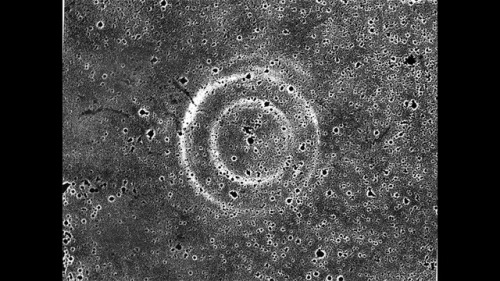
The Expanding Echoes of Supernova 1987A #119 Can you find supernova 1987A? It isn’t hard – it occurred at the center of the expanding bullseye pattern. Although this stellar detonation was first seen in 1987, light from SN 1987A continued to bounce off clumps of interstellar dust and be reflected to us even many years later. Light echoes recorded between 1988 and 1992 by the Anglo Australian Telescope (AAT) in Australia are shown moving out from the position of the supernova in the featured time-lapse sequence. These images were composed by subtracting an LMC image taken before the supernova light arrived from later LMC images that included the supernova echo. Other prominent light echo sequences include those taken by the EROS2 and SuperMACHO sky monitoring projects. Studies of expanding light echo rings around other supernovas have enabled more accurate determinations of the location, date, and symmetry of these tremendous stellar explosions. Yesterday marked the 32nd anniversary of SN 1987A: the last recoded supernova in or around our Milky Way Galaxy, and the last to be visible to the unaided eye. via NASA https://apod.nasa.gov/apod/ap190224.html


from WordPress https://vladislavkarelin.wordpress.com/2019/02/24/the-expanding-echoes-of-supernova-1987a-119-can-you-find/


https://66.media.tumblr.com/e91afcbe5346b1c4c83a8ca9f3cf127b/tumblr_pnf1sinOLC1xorz76o1_500.jpg

23 февраля 2019 г.

The Stars of the Triangulum Galaxy #119 Like grains of sand on…

The Stars of the Triangulum Galaxy #119 Like grains of sand on a cosmic beach, stars of the Triangulum Galaxy are resolved in this sharp mosaic from the Hubble Space Telescope’s Advanced Camera for Surveys (ACS). The inner region of the galaxy spanning over 17,000 light-years is covered at extreme resolution, the second largest image ever released by Hubble. At its center is the bright, densely packed galactic core surrounded by a loose array of dark dust lanes mixed with the stars in the galactic plane. Also known as M33, the face-on spiral galaxy lies 3 million light-years away in the small northern constellation Triangulum. Over 50,000 light-years in diameter, the Triangulum Galaxy is the third largest in the Local Group of galaxies after the Andromeda Galaxy (M31), and our own Milky Way. Of course, to fully appreciate the Triangulum’s stars, star clusters, and bright nebulae captured in this Hubble mosaic, you’ll need to use a zoom tool. via NASA https://apod.nasa.gov/apod/ap190223.html


from WordPress https://vladislavkarelin.wordpress.com/2019/02/23/the-stars-of-the-triangulum-galaxy-119-like-grains-of-sand-on/


https://66.media.tumblr.com/afbebe200999cf6954d538a9c6c4a1e6/tumblr_pnd75cC1XW1xorz76o1_500.jpg

22 февраля 2019 г.

#43ap Wikipedia picture of the day on February 22,…

#43ap Wikipedia picture of the day on February 22, 2019:
Sunflower at a field in Köcking, market town Eberndorf, district Völkermarkt, Carinthia, Austria, EU
Eberndorf Köcking Sonnenblumenfeld Biohof Tomic 18072014 0792.jpg.


from WordPress https://vladislavkarelin.wordpress.com/2019/02/22/43ap-wikipedia-picture-of-the-day-on-february-22/


https://66.media.tumblr.com/90765777216a68016fc730f1f2571c26/tumblr_pnawfbrcHy1xorz76o1_500.jpg

18 февраля 2019 г.

Dragon Aurora over Iceland #119 Have you ever seen a dragon in…

Dragon Aurora over Iceland #119 Have you ever seen a dragon in the sky? Although real flying dragons don’t exist, a huge dragon-shaped aurora developed in the sky over Iceland earlier this month. The aurora was caused by a hole in the Sun’s corona that expelled charged particles into a solar wind that followed a changing interplanetary magnetic field to Earth’s magnetosphere. As some of those particles then struck Earth’s atmosphere, they excited atoms which subsequently emitted light: aurora. This iconic display was so enthralling that the photographer’s mother ran out to see it and was captured in the foreground. No sunspots have appeared on the Sun so far in February, making the multiple days of picturesque auroral activity this month somewhat surprising. via NASA https://apod.nasa.gov/apod/ap190218.html


from WordPress https://vladislavkarelin.wordpress.com/2019/02/18/dragon-aurora-over-iceland-119-have-you-ever-seen-a-dragon-in/


https://66.media.tumblr.com/0656b09b12acf0adc9da93ea89ad592e/tumblr_pn3xt3ImvD1xorz76o1_500.jpg

16 февраля 2019 г.

NGC 2359: Thor s Helmet #119 NGC 2359 is a helmet-shaped cosmic…

NGC 2359: Thor s Helmet #119 NGC 2359 is a helmet-shaped cosmic cloud with wing-like appendages popularly called Thor’s Helmet. Heroically sized even for a Norse god, Thor’s Helmet is about 30 light-years across. In fact, the helmet is more like an interstellar bubble, blown as a fast wind from the bright, massive star near the bubble’s center inflates a region within the surrounding molecular cloud. Known as a Wolf-Rayet star, the central star is an extremely hot giant thought to be in a brief, pre-supernova stage of evolution. NGC 2359 is located about 15,000 light-years away in the constellation Canis Major. The remarkably detailed image is a mixed cocktail of data from broadband and narrowband filters that captures natural looking stars and the glow of the nebula’s filamentary structures. It highlights a blue-green color from strong emission due to oxygen atoms in the glowing gas. via NASA https://apod.nasa.gov/apod/ap190216.html


from WordPress https://vladislavkarelin.wordpress.com/2019/02/16/ngc-2359-thor-s-helmet-119-ngc-2359-is-a-helmet-shaped-cosmic/


https://66.media.tumblr.com/4e84bca8d1b4311b5538643a7e217aa2/tumblr_pn08hc5goB1xorz76o1_500.jpg

12 февраля 2019 г.

Plane Crossing a Crescent Moon #119 No, this is not a good way…

Plane Crossing a Crescent Moon #119 No, this is not a good way to get to the Moon. What is pictured is a chance superposition of an airplane and the Moon. The contrail would normally appear white, but the large volume of air toward the setting Sun preferentially knocks away blue light, giving the reflected trail a bright red hue. Far in the distance, well behind the plane, is a crescent Moon, also slightly reddened. Captured a month ago above Valais, Switzerland, the featured image was taken so soon after sunset that planes in the sky were still in sunlight, as were their contrails. Within minutes, unfortunately, the impromptu sky show ended. The plane crossed the Moon and moved out of sight. The Moon set. The contrail became unilluminated and then dispersed. via NASA https://apod.nasa.gov/apod/ap190212.html


from WordPress https://vladislavkarelin.wordpress.com/2019/02/12/plane-crossing-a-crescent-moon-119-no-this-is-not-a-good-way/


https://66.media.tumblr.com/3f1da589c2f39bb5c1d939ed8d89605d/tumblr_pmstt28RyG1xorz76o1_500.jpg

8 февраля 2019 г.

Moon, Four Planets, and Emu #119 A luminous Milky Way falls…

Moon, Four Planets, and Emu #119 A luminous Milky Way falls toward the horizon in this deep skyscape, starting at the top of the frame from the stars of the Southern Cross and the dark Coalsack Nebula. Captured in the dark predawn of February 2nd from Central Victoria, Australia, planet Earth, the 26 day old waning crescent Moon still shines brightly near the horizon. The second and third brightest celestial beacons are Venus and Jupiter along the lower part of the Milky Way’s central bulge. Almost in line with the brighter planets and Moon, Saturn is the pinprick of light just visible below and right of the lunar glow. Australia’s first astronomers saw the elongated, bulging shape of the familiar Milky Way as a great celestial Emu. The Moon and planets could almost be the Emu’s eggs on this starry night. via NASA https://apod.nasa.gov/apod/ap190208.html


from WordPress https://vladislavkarelin.wordpress.com/2019/02/08/moon-four-planets-and-emu-119-a-luminous-milky-way-falls/


https://66.media.tumblr.com/32db3d839604104076f76e1933303e99/tumblr_pmlf57t66y1xorz76o1_500.jpg

6 февраля 2019 г.

Moon and Venus Appulse over a Tree #119 What’s that…

Moon and Venus Appulse over a Tree #119 What’s that bright spot near the Moon? Venus. About a week ago, Earth’s Moon appeared unusually close to the distant planet Venus, an angular coincidence known as an appulse. Similar to a conjunction, which is a coordinate term, an appulse refers more generally to when two celestial objects appear close together. This Moon and Venus appulse – once as close as 0.05 degrees – was captured rising during the early morning behind Koko crater on the island of O’ahu in Hawaii, USA. The Moon was in a crescent phase with its lower left reflecting direct sunlight, while the rest of the Moon is seen because of Earthshine, sunlight first reflected from the Earth. Some leaves and branches of a foreground kiawe tree are seen in silhouette in front of the bright crescent, while others, in front of a darker background, appear white because of forward scattering. Appulses involving the Moon typically occur several times a year: for example the Moon is expected to pass within 0.20 degrees of distant Saturn on March 1. via NASA https://apod.nasa.gov/apod/ap190206.html


from WordPress https://vladislavkarelin.wordpress.com/2019/02/06/moon-and-venus-appulse-over-a-tree-119-whats-that/


https://66.media.tumblr.com/cd31d8736c46d474ef420ff7da0b5b1e/tumblr_pmhpsejHg31xorz76o1_500.jpg

5 февраля 2019 г.

Star Formation in the Orion Nebula #116 The powerful wind from…

Star Formation in the Orion Nebula #116 The powerful wind from the newly formed star at the heart of the Orion Nebula is creating the bubble and preventing new stars from forming. via NASA http://www.nasa.gov/image-feature/star-formation-in-the-orion-nebula


from WordPress https://vladislavkarelin.wordpress.com/2019/02/05/star-formation-in-the-orion-nebula-116-the-powerful-wind-from/


https://66.media.tumblr.com/18f519be139a63ff5cb1cc2a0c52af26/tumblr_pmgtl5obdI1xorz76o1_500.png

4 февраля 2019 г.

Henize 70: A Superbubble in the LMC #119 Massive stars…

Henize 70: A Superbubble in the LMC #119 Massive stars profoundly affect their galactic environments. Churning and mixing interstellar clouds of gas and dust, stars – most notably those upwards of tens of times the mass of our Sun – leave their mark on the compositions and locations of future generations of stars. Dramatic evidence of this is illustrated in our neighboring galaxy, the Large Magellanic Cloud (LMC), by the featured nebula, Henize 70 (also known as N70 and DEM301). Henize 70 is actually a luminous superbubble of interstellar gas about 300 light-years in diameter, blown by winds from hot, massive stars and supernova explosions, with its interior filled with tenuous hot and expanding gas. Because superbubbles can expand through an entire galaxy, they offer humanity a chance to explore the connection between the lifecycles of stars and the evolution of galaxies. via NASA https://apod.nasa.gov/apod/ap190204.html


from WordPress https://vladislavkarelin.wordpress.com/2019/02/04/henize-70-a-superbubble-in-the-lmc-119-massive-stars/


https://66.media.tumblr.com/ca89ca7cbedf837b615675560ea3278d/tumblr_pme0h9RkQz1xorz76o1_500.jpg

1 февраля 2019 г.

Twin Galaxies in Virgo #119 Spiral galaxy pair NGC 4567 and NGC…

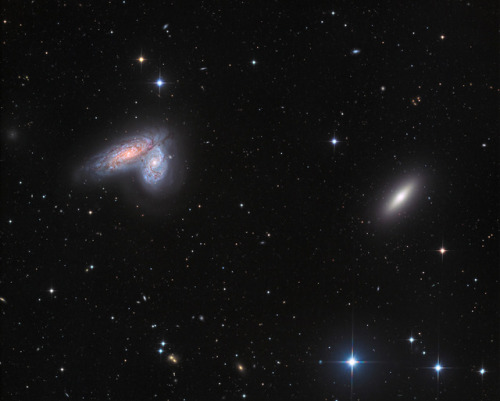
Twin Galaxies in Virgo #119 Spiral galaxy pair NGC 4567 and NGC 4568 share this sharp cosmic vista with lonely elliptical galaxy NGC 4564. All are members of the large Virgo Galaxy Cluster. With their classic spiral arms, dust lanes, and star clusters, the eye-catching spiral pair is also known as the Butterfly Galaxies or the Siamese Twins. Very close together, the galaxy twins don’t seem to be too distorted by gravitational tides. Their giant molecular clouds are known to be colliding though and are likely fueling the formation of massive star clusters. The galaxy twins are about 52 million light-years distant, while their bright cores appear separated by about 20,000 light-years. Of course, the spiky foreground stars lie within our own Milky Way. via NASA https://apod.nasa.gov/apod/ap190201.html


from WordPress https://vladislavkarelin.wordpress.com/2019/02/01/twin-galaxies-in-virgo-119-spiral-galaxy-pair-ngc-4567-and-ngc/


https://66.media.tumblr.com/d13d32915e9066b02733fad531099926/tumblr_pm8ghrNZKV1xorz76o1_500.jpg

29 января 2019 г.

Ultima Thule from New Horizons #119 How do distant asteroids…

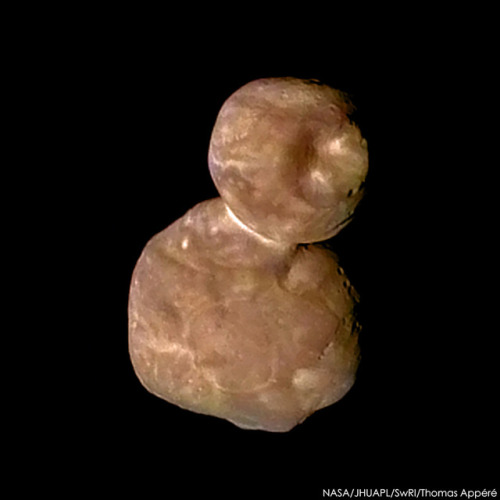
Ultima Thule from New Horizons #119 How do distant asteroids differ from those near the Sun? To help find out, NASA sent the robotic New Horizons spacecraft past the classical Kuiper belt object 2014 MU69, nicknamed Ultima Thule, the farthest asteroid yet visited by a human spacecraft. Zooming past the 30-km long space rock on January 1, the featured image is the highest resolution picture of Ultima Thule’s surface beamed back so far. Utima Thuli does look different than imaged asteroids of the inner Solar System, as it shows unusual surface texture, relatively few obvious craters, and nearly spherical lobes. Its shape is hypothesized to have formed from the coalescence of early Solar System rubble in into two objects – Ultima and Thule – which then spiraled together and stuck. Research will continue into understanding the origin of different surface regions on Ultima Thule, whether it has a thin atmosphere, how it obtained its red color, and what this new knowledge of the ancient Solar System tells us about the formation of our Earth. via NASA https://apod.nasa.gov/apod/ap190129.html


from WordPress https://vladislavkarelin.wordpress.com/2019/01/29/ultima-thule-from-new-horizons-119-how-do-distant-asteroids/


https://66.media.tumblr.com/84cf7272773ccec24f07a5edb84b2bf1/tumblr_pm2wkxWUJ91xorz76o1_500.jpg

4 января 2019 г.

#119 Ultima Thule is the most distant world explored by a…

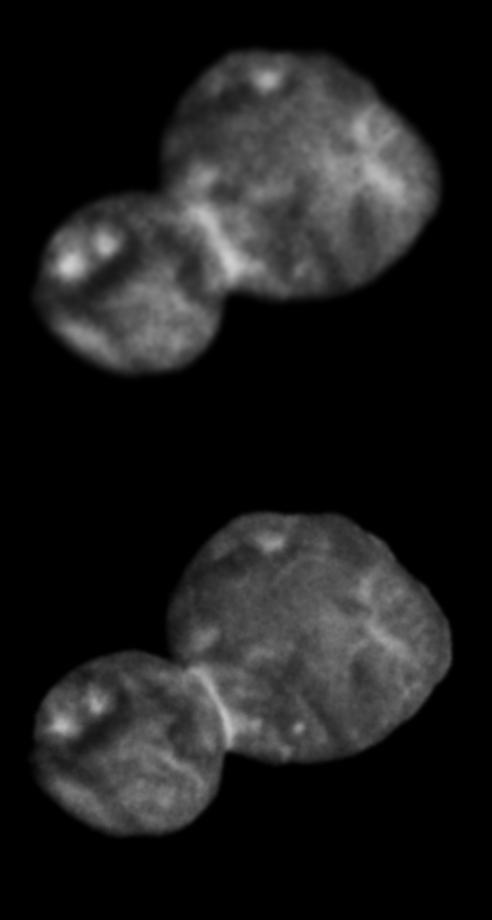
#119 Ultima Thule is the most distant world explored by a spacecraft from Earth. In the dim light 6.5 billion kilometers from the Sun, the New Horizons spacecraft captured these two frames 38 minutes apart as it sped toward the Kuiper belt world on January 1 at 51,000 kilometers per hour. A contact binary, the two lobes of Ultima Thule rotate together once every 15 hours or so. Shown as a blinking gif, the rotation between the frames produces a tantalizing 3D perspective of the most primitive world ever seen. Dubbed separately by the science team Ultima and Thule, the larger lobe Ultima, is about 19 kilometers in diameter. Smaller Thule is 14 kilometers across. via NASA https://apod.nasa.gov/apod/ap190104.html


from WordPress https://vladislavkarelin.wordpress.com/2019/01/04/119-ultima-thule-is-the-most-distant-world-explored-by-a/


https://66.media.tumblr.com/8f8dbfe2f982773c8a8359c98000e062/tumblr_pkslsxP2Qk1xorz76o1_500.gif

1 января 2019 г.

The Sombrero Galaxy in Infrared #119 This floating ring is the…

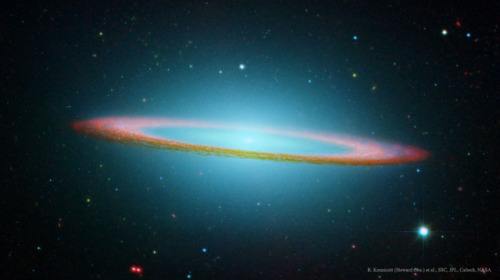
The Sombrero Galaxy in Infrared #119 This floating ring is the size of a galaxy. In fact, it is a galaxy – or at least part of one: the photogenic Sombrero Galaxy, one of the largest galaxies in the nearby Virgo Cluster of Galaxies. The dark band of dust that obscures the mid-section of the Sombrero Galaxy in optical light actually glows brightly in infrared light. The featured image, digitally sharpened, shows the infrared glow, recently recorded by the orbiting Spitzer Space Telescope, superposed in false-color on an existing image taken by NASA’s Hubble Space Telescope in optical light. The Sombrero Galaxy, also known as M104, spans about 50,000 light years across and lies 28 million light years away. M104 can be seen with a small telescope in the direction of the constellation Virgo. via NASA https://apod.nasa.gov/apod/ap190101.html


from WordPress https://vladislavkarelin.wordpress.com/2019/01/01/the-sombrero-galaxy-in-infrared-119-this-floating-ring-is-the/


https://66.media.tumblr.com/8eeca4e0df8731bf23a18f9994da0831/tumblr_pkn1shLkTl1xorz76o1_500.jpg