30 июня 2019 г.

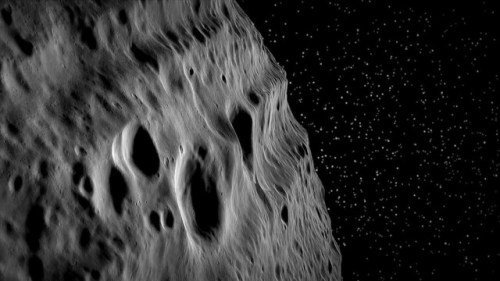
Virtual Flight over Asteroid Vesta #119 What would it be like…

Virtual Flight over Asteroid Vesta #119 What would it be like to fly over the asteroid Vesta? Animators from the German Aerospace Center took actual images and height data from NASA’s Dawn mission when it visited asteroid Vesta a few years ago and generated a virtual movie. The featured video begins with a sequence above Divalia Fossa, an unusual pair of troughs running parallel over heavily cratered terrain. Next, the virtual spaceship explores Vesta’s 60-km Marcia Crater, showing numerous vivid details. Last, Dawn images were digitally recast with exaggerated height to better reveal Vesta’s 5-km high mountain Aricia Tholus. The second largest object in the Solar System’s asteroid belt, Vesta is the brightest asteroid visible from Earth and can be found with binoculars. Using Vesta Trek, you can explore all over Vesta yourself. via NASA https://apod.nasa.gov/apod/ap190630.html


from WordPress https://vladislavkarelin.wordpress.com/2019/06/30/virtual-flight-over-asteroid-vesta-119-what-would-it-be-like/


https://66.media.tumblr.com/d799cff7375d07760e61e0d4103438ee/tumblr_ptwb0m1ckP1xorz76o1_500.jpg

11 июня 2019 г.

The Cave Nebula in Infrared from Spitzer #119 What’s…

The Cave Nebula in Infrared from Spitzer #119 What’s happening in and around the Cave Nebula? To help find out, NASA’s orbiting Spitzer Space Telescope looked into this optically-dark star-forming region in four colors of infrared light. The Cave Nebula, cataloged as Sh2-155, is quite bright in infrared, revealing details not only of internal pillars of gas and dust, but of the illuminating star cluster too — all near the top of the image. The red glow around the Cave’s entrance is created by dust heated by bright young stars. To the right is Cepheus B, a star cluster that formed previously from the same cloud of gas and dust. Other interesting stars of Cepheus come to light in infrared as well, including those illuminating an even younger nebula toward the image bottom, and a runaway star pushing a bow shock, tinged in red near the image center. This region spans about 50 light years and lies about 2,500 light years toward the constellation of the King of Aethiopia (Cepheus). via NASA https://apod.nasa.gov/apod/ap190611.html


from WordPress https://vladislavkarelin.wordpress.com/2019/06/11/the-cave-nebula-in-infrared-from-spitzer-119-whats/


https://66.media.tumblr.com/57e250c5e36fc2787c0ac13ce77446b2/tumblr_psx4de0KCF1xorz76o1_500.jpg