10 мая 2020 г.

The Porpoise Galaxy from Hubble #119 What’s happening to…

The Porpoise Galaxy from Hubble #119 What’s happening to this spiral galaxy? Just a few hundred million years ago, NGC 2936, the upper of the two large galaxies shown, was likely a normal spiral galaxy – spinning, creating stars – and minding its own business. But then it got too close to the massive elliptical galaxy NGC 2937 below and took a dive. Dubbed the Porpoise Galaxy for its iconic shape, NGC 2936 is not only being deflected but also being distorted by the close gravitational interaction. A burst of young blue stars forms the nose of the porpoise toward the right of the upper galaxy, while the center of the spiral appears as an eye. Alternatively, the galaxy pair, together known as Arp 142, look to some like a penguin protecting an egg. Either way, intricate dark dust lanes and bright blue star streams trail the troubled galaxy to the lower right. The featured re-processed image showing Arp 142 in unprecedented detail was taken by the Hubble Space Telescope last year. Arp 142 lies about 300 million light years away toward the constellation, coincidently, of the Water Snake (Hydra). In a billion years or so the two galaxies will likely merge into one larger galaxy. via NASA https://apod.nasa.gov/apod/ap200510.html


from WordPress https://vladislavkarelin.wordpress.com/2020/05/10/the-porpoise-galaxy-from-hubble-119-whats-happening-to/


https://66.media.tumblr.com/159169aa706955fe6c623ed7320d745b/7e82727b8b2cb6f1-bb/s500x750/b724462d1d444b6e31a221a34a4551b8a986d9e6.jpg

8 мая 2020 г.

Long Tailed Comet SWAN #119 Blowing in the solar wind the…

Long Tailed Comet SWAN #119 Blowing in the solar wind the spectacular ion tail of Comet SWAN (C/2020 F8) extends far across this 10 degree wide telephoto field of view. Captured on May 2 its greenish coma was about 6 light-minutes from Earth. The pretty background starfield lies near the border of the constellations Cetus and Aquarius. This comet SWAN was discovered at home by Australian amateur Michael Mattiazzo by checking images from the Sun-staring SOHO spacecraft’s SWAN (Solar Wind ANisotropies) camera. The comet has now become just visible to the naked-eye as it sweeps from southern to northern skies. Appearing in morning twilight near the eastern horizon, Comet SWAN will make its closest approach to planet Earth on May 12 and reach perihelion on May 27.

via NASA https://apod.nasa.gov/apod/ap200508.html


from WordPress https://vladislavkarelin.wordpress.com/2020/05/08/long-tailed-comet-swan-119-blowing-in-the-solar-wind-the/


https://66.media.tumblr.com/bd2f46f44f77fa983f9dda121ea6799e/9161aa73f0331418-68/s500x750/ff364ce327ed5ee8faea31bad2e35000b9ed9944.jpg

7 мая 2020 г.

Analemma of the Moon #119 An analemma is that figure-8 curve…

Analemma of the Moon #119 An analemma is that figure-8 curve you get when you mark the position of the Sun at the same time each day for one year. But the trick to imaging an analemma of the Moon is to wait bit longer. On average the Moon returns to the same position in the sky about 50 minutes and 29 seconds later each day. So photograph the Moon 50 minutes 29 seconds later on successive days. Over one lunation or lunar month it will trace out an analemma-like curve as the Moon’s actual position wanders due to its tilted and elliptical orbit. To create this composite image of a lunar analemma, astronomer Gyorgy Soponyai chose a lunar month from March 26 to April 18 with a good stretch of weather and a site close to home near Mogyorod, Hungary. Crescent lunar phases too thin and faint to capture around the New Moon are missing though. Facing southwest, the lights of Budapest are in the distance of the base image taken on March 27.

via NASA https://apod.nasa.gov/apod/ap200507.html


from WordPress https://vladislavkarelin.wordpress.com/2020/05/07/analemma-of-the-moon-119-an-analemma-is-that-figure-8-curve/


https://66.media.tumblr.com/8db7fc5be0a8d2df8275e43bfd9514fb/d0c4b01d24274bdf-60/s500x750/36688c51571122246083a0c515f40dfbc7e10ee9.jpg

6 мая 2020 г.

LDN 1471: A Windblown Star Cavity #119 What is the cause of…

LDN 1471: A Windblown Star Cavity #119 What is the cause of this unusual parabolic structure? This illuminated cavity, known as LDN 1471, was created by a newly forming star, seen as the bright source at the peak of the parabola. This protostar is experiencing a stellar outflow which is then interacting with the surrounding material in the Perseus Molecular Cloud, causing it to brighten. We see only one side of the cavity – the other side is hidden by dark dust. The parabolic shape is caused by the widening of the stellar-wind blown cavity over time. Two additional structures can also be seen either side of the protostar, these are known as Herbig-Haro objects, again caused by the interaction of the outflow with the surrounding material. What causes the striations on the cavity walls, though, remains unknown. The featured image was taken by NASA and ESA��������s Hubble Space Telescope after an original detection by the Spitzer Space Telescope. via NASA https://apod.nasa.gov/apod/ap200506.html


from WordPress https://vladislavkarelin.wordpress.com/2020/05/06/ldn-1471-a-windblown-star-cavity-119-what-is-the-cause-of/


https://66.media.tumblr.com/a15410e39160d0418289bb8df8dec863/ef4fb86970d41dc6-1a/s500x750/1dedcafda6ca09c3f842129c3dcec946e5d9e3c8.jpg

23 апреля 2020 г.

#43ap Wikipedia picture of the day on April 23, 2020: Female…

#43ap Wikipedia picture of the day on April 23, 2020:
Female southern masked weaver bird (Ploceus velatus) with tongue out and toes crossed.
Ploceus velatus beak open.jpg.

from WordPress https://vladislavkarelin.wordpress.com/2020/04/23/43ap-wikipedia-picture-of-the-day-on-april-23-2020-female/

via Blogger http://vladislav-karelin.blogspot.com/2020/04/43ap-wikipedia-picture-of-day-on-april_57.html #181ap

from WordPress https://vladislavkarelin.wordpress.com/2020/04/23/43ap-wikipedia-picture-of-the-day-on-april-23-2020-female-2/

via Blogger http://vladislav-karelin.blogspot.com/2020/04/43ap-wikipedia-picture-of-day-on-april_94.html #181ap

from WordPress https://vladislavkarelin.wordpress.com/2020/04/23/43ap-wikipedia-picture-of-the-day-on-april-23-2020-female-3/

via Blogger http://vladislav-karelin.blogspot.com/2020/04/43ap-wikipedia-picture-of-day-on-april_67.html #181ap

from WordPress https://vladislavkarelin.wordpress.com/2020/04/23/43ap-wikipedia-picture-of-the-day-on-april-23-2020-female-4/

via Blogger http://vladislav-karelin.blogspot.com/2020/04/43ap-wikipedia-picture-of-day-on-april_77.html #181ap


from WordPress https://vladislavkarelin.wordpress.com/2020/04/23/43ap-wikipedia-picture-of-the-day-on-april-23-2020-female-5/


https://66.media.tumblr.com/5e173291ffbdedd3efa8cf9fafdd12a2/288771e61e926083-b4/s500x750/89d3ea6a8caff9be5ae044748d2dff01dd2f5688.jpg

21 апреля 2020 г.

Eye on the Milky Way #119 Have you ever had stars in your…

Eye on the Milky Way #119 Have you ever had stars in your eyes? It appears that the eye on the left does, and moreover it appears to be gazing at even more stars. The featured 27-frame mosaic was taken last July from Ojas de Salar in the Atacama Desert of Chile. The eye is actually a small lagoon captured reflecting the dark night sky as the Milky Way Galaxy arched overhead. The seemingly smooth band of the Milky Way is really composed of billions of stars, but decorated with filaments of light-absorbing dust and red-glowing nebulas. Additionally, both Jupiter (slightly left the galactic arch) and Saturn (slightly to the right) are visible. The lights of small towns dot the unusual vertical horizon. The rocky terrain around the lagoon appears to some more like the surface of Mars than our Earth. via NASA https://apod.nasa.gov/apod/ap200421.html


from WordPress https://vladislavkarelin.wordpress.com/2020/04/21/eye-on-the-milky-way-119-have-you-ever-had-stars-in-your/


https://66.media.tumblr.com/9dbfe238fa55ab8307dfec066fd683e9/6b508d89f34cdcd1-79/s500x750/d9da8b1e25b8c8dc94d72df68660d61923d87840.jpg

20 апреля 2020 г.

IC 2944: The Running Chicken Nebula #119 To some, it looks…

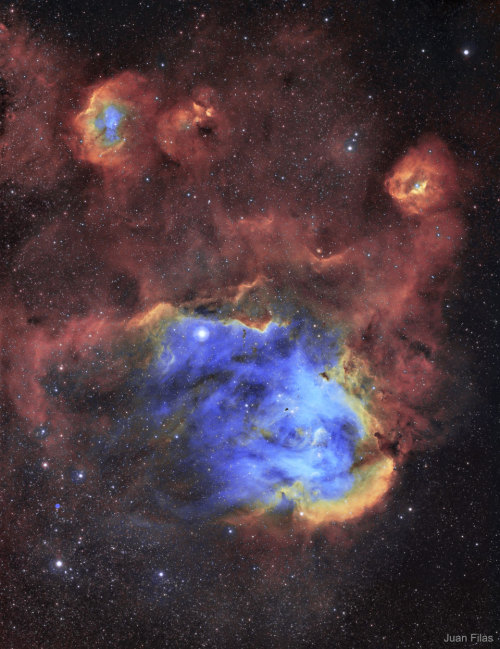
IC 2944: The Running Chicken Nebula #119 To some, it looks like a giant chicken running across the sky. To others, it looks like a gaseous nebula where star formation takes place. Cataloged as IC 2944, the Running Chicken Nebula spans about 100 light years and lies about 6,000 light years away toward the constellation of the Centaur (Centaurus). The featured image, shown in scientifically assigned colors, was captured recently in a 12-hour exposure. The star cluster Collinder 249 is visible embedded in the nebula’s glowing gas. Although difficult to discern here, several dark molecular clouds with distinct shapes can be found inside the nebula. via NASA https://apod.nasa.gov/apod/ap200420.html


from WordPress https://vladislavkarelin.wordpress.com/2020/04/20/ic-2944-the-running-chicken-nebula-119-to-some-it-looks/


https://66.media.tumblr.com/e49d2539483f575791ee0128f8ce816e/5010f7aee5a23e53-7a/s500x750/c94d5396778134bb4277fa4409b3dbf638d0e326.jpg

14 апреля 2020 г.

NGC 253: The Silver Coin Galaxy #119 NGC 253 is one of the…

NGC 253: The Silver Coin Galaxy #119 NGC 253 is one of the brightest spiral galaxies visible, but also one of the dustiest. Dubbed the Silver Coin for its appearance in smalltelescopes, it is more formally known as the Sculptor Galaxy for its location within the boundaries of the southern constellation Sculptor. Discovered in 1783 by mathematician and astronomer Caroline Herschel, the dusty island universe lies a mere 10 million light-years away. About 70 thousand light-years across, NGC 253, pictured, is the largest member of the Sculptor Group of Galaxies, the nearest to our own Local Group of galaxies. In addition to its spiral dust lanes, tendrils of dust seem to be rising from a galactic disk laced with young star clusters and star forming regions in this sharp color image. The high dust content accompanies frantic star formation, earning NGC 253 the designation of a starburst galaxy. NGC 253 is also known to be a strong source of high-energy x-rays and gamma rays, likely due to massive black holes near the galaxy’s center. Take a trip through extragalactic space in this short video flyby of NGC 253. via NASA https://apod.nasa.gov/apod/ap200414.html


from WordPress https://vladislavkarelin.wordpress.com/2020/04/14/ngc-253-the-silver-coin-galaxy-119-ngc-253-is-one-of-the/


https://66.media.tumblr.com/fd073b917a205604bb7c17a027f41b8b/b64626e6100503fc-df/s500x750/67eb26ffd60145399094bf13b19389eed225cc1e.jpg

#43ap Wikipedia picture of the day on April 14, 2020: View of a…

#43ap Wikipedia picture of the day on April 14, 2020:
View of a lake in the Eagle River Valley, Municipality of Anchorage, Alaska, United States.
Parque Eagle River, Anchorage, Alaska, Estados Unidos, 2017-09-01, DD 02.jpg.


from WordPress https://vladislavkarelin.wordpress.com/2020/04/14/43ap-wikipedia-picture-of-the-day-on-april-14-2020-view-of-a/


https://66.media.tumblr.com/83a03a373f4b978cf945816e612c43b7/f612cb779d71ba34-21/s500x750/5e7cb967f92ec5192e53e3b25a07a3794c4fc91e.jpg

13 апреля 2020 г.

A Sailing Stone across Death Valley #119 How did this big rock…

A Sailing Stone across Death Valley #119 How did this big rock end up on this strange terrain? One of the more unusual places here on Earth occurs inside Death Valley, California, USA. There a dried lakebed named Racetrack Playa exists that is almost perfectly flat, with the odd exception of some very large stones, one of which is pictured here in April of 2019 beneath a dark, Milky-Way filled sky. Now the flatness and texture of large playa like Racetrack are fascinating but not scientifically puzzling – they are caused by mud flowing, drying, and cracking after a heavy rain. Only recently, however, has a viable scientific hypothesis been given to explain how heavy sailing stones end up near the middle of such a large flat surface. Unfortunately, as frequently happens in science, a seemingly surreal problem ends up having a relatively mundane solution. It turns out that in winter thin ice sheets form, and winds push ice sections laden with even heavy rocks across the temporarily slick playa when sunlight melts the ice. via NASA https://apod.nasa.gov/apod/ap200413.html


from WordPress https://vladislavkarelin.wordpress.com/2020/04/13/a-sailing-stone-across-death-valley-119-how-did-this-big-rock/


https://66.media.tumblr.com/c98e4d57da45afb8551afc97dfc3651d/cbc4a51ce10d0056-ca/s500x750/6e673c3c9d3ab8ebd79aafb1be35634638af331d.jpg

10 апреля 2020 г.

Full Moon of Spring #119 From home this Full Moon looked…

Full Moon of Spring #119 From home this Full Moon looked bright. Around our fair planet it rose as the Sun set on April 7/8, the first Full Moon after the vernal equinox and the start of northern hemisphere spring. April’s full lunar phase was also near perigee, the closest point in the Moon’s elliptical orbit. In fact, it was nearer perigee than any other Full Moon of 2020 making it the brightest Full Moon of the year. To create the visual experience a range of exposures were blended to capture the emerging foreground foliage and bright lunar disk. The hopefull image of spring was recorded from a home garden in skies over Chongqing, China. via NASA https://apod.nasa.gov/apod/ap200410.html


from WordPress https://vladislavkarelin.wordpress.com/2020/04/10/full-moon-of-spring-119-from-home-this-full-moon-looked/


https://66.media.tumblr.com/de58f931bfee68b14ee7cb5a4b87d9a5/6768f8fcf4eef4c9-bf/s500x750/143dd7379c672ce51d32224af8f7254b4e2424f1.jpg

6 апреля 2020 г.

NGC 1672: Barred Spiral Galaxy from Hubble #119 Many spiral…

NGC 1672: Barred Spiral Galaxy from Hubble #119 Many spiral galaxies have bars across their centers. Even our own Milky Way Galaxy is thought to have a modest central bar. Prominently barred spiral galaxy NGC 1672, featured here, was captured in spectacular detail in an image taken by the orbiting Hubble Space Telescope. Visible are dark filamentary dust lanes, young clusters of bright blue stars, red emission nebulas of glowing hydrogen gas, a long bright bar of stars across the center, and a bright active nucleus that likely houses a supermassive black hole. Light takes about 60 million years to reach us from NGC 1672, which spans about 75,000 light years across. NGC 1672, which appears toward the constellation of the Dolphinfish (Dorado), has been studied to find out how a spiral bar contributes to star formation in a galaxy’s central regions. via NASA https://apod.nasa.gov/apod/ap200406.html


from WordPress https://vladislavkarelin.wordpress.com/2020/04/06/ngc-1672-barred-spiral-galaxy-from-hubble-119-many-spiral/


https://66.media.tumblr.com/9a0309fced11ed1199534fd637ca2604/8065662ee515d4dd-55/s500x750/3d7decce04905206421a6752640ca5879614dc23.jpg

30 марта 2020 г.

The Colors of Saturn from Cassini #119 What creates…

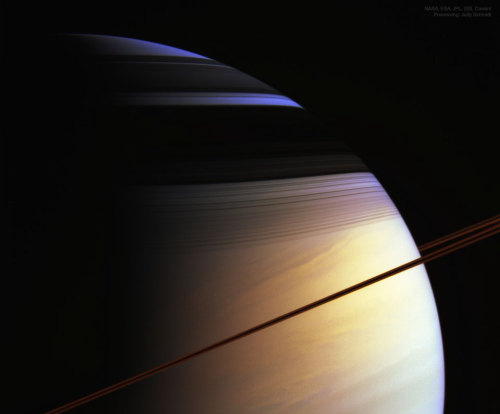
The Colors of Saturn from Cassini #119 What creates Saturn’s colors? The featured picture of Saturn only slightly exaggerates what a human would see if hovering close to the giant ringed world. The image was taken in 2005 by the robot Cassini spacecraft that orbited Saturn from 2004 to 2017. Here Saturn’s majestic rings appear directly only as a curved line, appearing brown, in part, from its infrared glow. The rings best show their complex structure in the dark shadows they create across the upper part of the planet. The northern hemisphere of Saturn can appear partly blue for the same reason that Earth’s skies can appear blue – molecules in the cloudless portions of both planet’s atmospheres are better at scattering blue light than red. When looking deep into Saturn’s clouds, however, the natural gold hue of Saturn’s clouds becomes dominant. It is not known why southern Saturn does not show the same blue hue – one hypothesis holds that clouds are higher there. It is also not known why some of Saturn’s clouds are colored gold. via NASA https://apod.nasa.gov/apod/ap200330.html


from WordPress https://vladislavkarelin.wordpress.com/2020/03/30/the-colors-of-saturn-from-cassini-119-what-creates/


https://66.media.tumblr.com/f366f5d6544a1b796fe3702847231f7d/3b3c4bcb3a0b35d3-f9/s500x750/9f109a72ab73f75ed3d8df7cbc40fb4b5687e976.jpg

29 марта 2020 г.

A 212 Hour Exposure of Orion #119 The constellation of Orion…

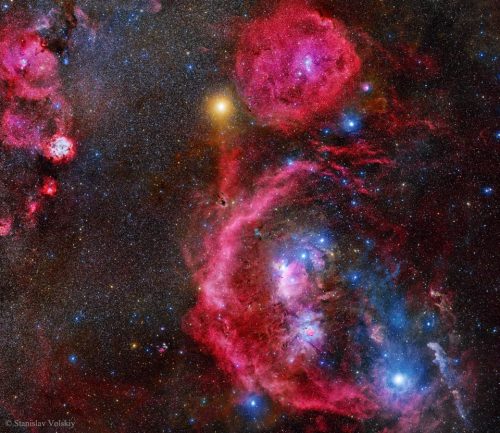
A 212 Hour Exposure of Orion #119 The constellation of Orion is much more than three stars in a row. It is a direction in space that is rich with impressive nebulas. To better appreciate this well-known swath of sky, an extremely long exposure was taken over many clear nights in 2013 and 2014. After 212 hours of camera time and an additional year of processing, the featured 1400-exposure collage spanning over 40 times the angular diameter of the Moon emerged. Of the many interesting details that have become visible, one that particularly draws the eye is Barnard’s Loop, the bright red circular filament arcing down from the middle. The Rosette Nebula is not the giant red nebula near the top of the image – that is a larger but lesser known nebula known as Lambda Orionis. The Rosette Nebula is visible, though: it is the red and white nebula on the upper left. The bright orange star just above the frame center is Betelgeuse, while the bright blue star on the lower right is Rigel. Other famous nebulas visible include the Witch Head Nebula, the Flame Nebula, the Fox Fur Nebula, and, if you know just where to look, the comparatively small Horsehead Nebula. About those famous three stars that cross the belt of Orion the Hunter – in this busy frame they can be hard to locate, but a discerning eye will find them just below and to the right of the image center. via NASA https://apod.nasa.gov/apod/ap200329.html


from WordPress https://vladislavkarelin.wordpress.com/2020/03/29/a-212-hour-exposure-of-orion-119-the-constellation-of-orion/


https://66.media.tumblr.com/5fcc008e14437a5f664e8451df871e3f/3e84bcaa0fb36982-c0/s500x750/1e6dd86d8abcbc5bf0d0bf3a82f072f6a4fcd191.jpg

28 марта 2020 г.

Stars Trail over Ragusa #119 In trying times, stars still trail…

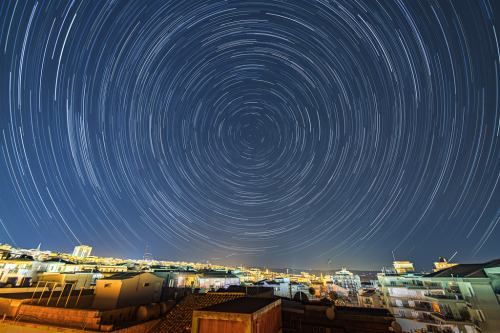
Stars Trail over Ragusa #119 In trying times, stars still trail in the night. Taken on March 14, this night skyscape was made by combining 230 exposures each 15 seconds long to follow the stars’ circular paths. The camera was fixed to a tripod on an isolated terrace near the center of Ragusa, Italy, on the island of Sicily. But the night sky was shared around the rotating planet. A friend to celestial navigators and astrophotographers alike Polaris, the north star, makes the short bright trail near the center of the concentric celestial arcs. via NASA https://apod.nasa.gov/apod/ap200328.html


from WordPress https://vladislavkarelin.wordpress.com/2020/03/28/stars-trail-over-ragusa-119-in-trying-times-stars-still-trail/


https://66.media.tumblr.com/1c6a5d6ec81d29818dceb33a70b7d5da/e05f67819ebe572c-93/s500x750/8d7768a9e89307041916d6152ea03dd9a7d97ef9.jpg

26 марта 2020 г.

Andromeda Station #119 This surreal picture isn’t from a…

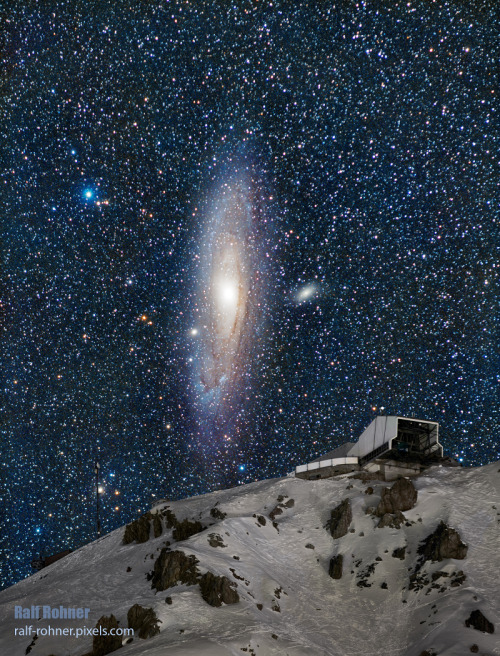
Andromeda Station #119 This surreal picture isn’t from a special effects sci-fi movie. It is a digital composite of frames of the real Andromeda Galaxy, also known as M31, rising over a real mountain. Exposures tracking the galaxy and background stars have been digitally combined with separate exposures of the foreground terrain. All background and foreground exposures were made back to back with the same camera and telephoto lens on the same night from the same location. In the “Deepscape” combination they produce a stunning image that reveals a range of brightness and color that your eye can’t quite see on its own. Still, it does look like you could ride a cable car up this mountain and get off at the station right next to Andromeda. But at 2.5 million light-years from Earth the big beautiful spiral galaxy really is a little out of reach as a destination. Don’t worry, though. Just wait 5 billion years and the Andromeda Galaxy will come to you. This Andromeda Station is better known as Weisshorn, the highest peak of the ski area in Arosa, Switzerland. via NASA https://apod.nasa.gov/apod/ap200326.html


from WordPress https://vladislavkarelin.wordpress.com/2020/03/26/andromeda-station-119-this-surreal-picture-isnt-from-a/


https://66.media.tumblr.com/b724ec2feb54d512d4e7addc28562f49/5a70443053c54035-9b/s500x750/0676a23fe48ca513cab4d055b03abda8d2081152.jpg

25 марта 2020 г.

Star Forming Region S106 #119 Massive star IRS 4 is beginning…

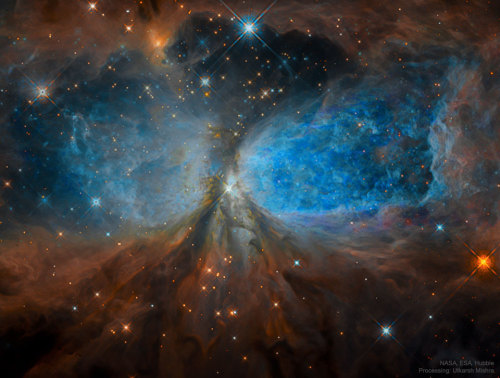
Star Forming Region S106 #119 Massive star IRS 4 is beginning to spread its wings. Born only about 100,000 years ago, material streaming out from this newborn star has formed the nebula dubbed Sharpless 2-106 Nebula (S106), featured here. A large disk of dust and gas orbiting Infrared Source 4 (IRS 4), visible in brown near the image center, gives the nebula an hourglass or butterfly shape. S106 gas near IRS 4 acts as an emission nebula as it emits light after being ionized, while dust far from IRS 4 reflects light from the central star and so acts as a reflection nebula. Detailed inspection of a relevant infrared image of S106 reveal hundreds of low-mass brown dwarf stars lurking in the nebula’s gas. S106 spans about 2 light-years and lies about 2000 light-years away toward the constellation of the Swan (Cygnus). via NASA https://apod.nasa.gov/apod/ap200325.html


from WordPress https://vladislavkarelin.wordpress.com/2020/03/25/star-forming-region-s106-119-massive-star-irs-4-is-beginning/


https://66.media.tumblr.com/f89da51278c1a0519eb37fd519139c0f/669e07e15f748ec4-4d/s500x750/13a9c129c084d5757f092d33bc2acb5f292326d6.jpg

24 марта 2020 г.

#43ap Wikipedia picture of the day on March 24, 2020: Exemplar…

#43ap Wikipedia picture of the day on March 24, 2020:
Exemplar of Lilac-breasted roller (Coracias caudata), Kruger National Park, South Africa.
Carraca lila (Coracias caudata), parque nacional Kruger, Sudáfrica, 2018-07-26, DD 17.jpg.


from WordPress https://vladislavkarelin.wordpress.com/2020/03/24/43ap-wikipedia-picture-of-the-day-on-march-24-2020-exemplar/


https://66.media.tumblr.com/2363d875b29d6e37652807d7538e5b74/1f698132233331ba-01/s500x750/af9b3f082d57e07d8292d75f0d0cb70aa0943ba5.jpg

17 марта 2020 г.

M77: Spiral Galaxy with an Active Center #119 What’s…

M77: Spiral Galaxy with an Active Center #119 What’s happening in the center of nearby spiral galaxy M77? The face-on galaxy lies a mere 47 million light-years away toward the constellation of the Sea Monster (Cetus). At that estimated distance, this gorgeous island universe is about 100 thousand light-years across. Also known as NGC 1068, its compact and very bright core is well studied by astronomers exploring the mysteries of supermassive black holes in active Seyfert galaxies. M77 and its active core glows bright at x-ray, ultraviolet, visible, infrared, and radio wavelengths. The featured sharp image of M77 was taken by the Hubble Space Telescope and is dominated by the (visible) red light emitted by hydrogen. The image shows details of the spiral’s winding spiral arms as traced by obscuring dust clouds, and red-tinted star forming regions close in to the galaxy’s luminous core. via NASA https://apod.nasa.gov/apod/ap200317.html


from WordPress https://vladislavkarelin.wordpress.com/2020/03/17/m77-spiral-galaxy-with-an-active-center-119-whats/


https://66.media.tumblr.com/72450528fca5fcc69ee0652ddaa2f9a4/cf1d0e5e3d8f8e1d-b4/s500x750/c98dacca504da66197974a2f9c3948c132dbd876.jpg

10 марта 2020 г.

Wide Field: Fox Fur, Unicorn, and Christmas Tree #119 What do…

Wide Field: Fox Fur, Unicorn, and Christmas Tree #119 What do the following things have in common: a cone, the fur of a fox, and a Christmas tree? Answer: they all occur in the constellation of the unicorn (Monoceros). Pictured as a star forming region and cataloged as NGC 2264, the complex jumble of cosmic gas and dust is about 2,700 light-years distant and mixes reddish emission nebulae excited by energetic light from newborn stars with dark interstellar dust clouds. Where the otherwise obscuring dust clouds lie close to the hot, young stars they also reflect starlight, forming blue reflection nebulae. The featured wide-field image spans over three times the diameter of a full moon, covering over 100 light-years at the distance of NGC 2264. Its cast of cosmic characters includes the Fox Fur Nebula, whose convoluted pelt lies just to the lower right of the image center, bright variable star S Mon visible just above the Fox Fur, and the Cone Nebula just to the left. Given their distribution, the stars of NGC 2264 are also known as the Christmas Tree star cluster. via NASA https://apod.nasa.gov/apod/ap200310.html


from WordPress https://vladislavkarelin.wordpress.com/2020/03/10/wide-field-fox-fur-unicorn-and-christmas-tree-119-what-do/


https://66.media.tumblr.com/13543293da65dc1de7588eafd2fa07b5/62a3a4db85a46ff7-fb/s500x750/85c9449f2bfaaf138309534130d1c932f2321e6c.jpg

9 марта 2020 г.

Milky Way and Zodiacal Light over Chile #119 What is the band…

Milky Way and Zodiacal Light over Chile #119 What is the band of light connecting the ground to the Milky Way? Zodiacal light – a stream of dust that orbits the Sun in the inner Solar System. It is most easily seen just before sunrise, where it has been called a false dawn, or just after sunset. The origin of zodiacal dust remains a topic of research, but is hypothesized to result from asteroid collisions and comet tails. The featured wide-angle image shows the central band of our Milky Way Galaxy arching across the top, while the Large Magellanic Cloud (LMC), a satellite galaxy to our Milky Way, is visible on the far left. The image is a combination of over 30 exposures taken last July near La Serena among the mountains of Chile. During the next two months, zodiacal light can appear quite prominent in northern skies just after sunset. via NASA https://apod.nasa.gov/apod/ap200309.html


from WordPress https://vladislavkarelin.wordpress.com/2020/03/09/milky-way-and-zodiacal-light-over-chile-119-what-is-the-band/


https://66.media.tumblr.com/9c5a43c446fd8fd676f127d074020893/b9a7fc4ee0949ba3-f4/s500x750/8baea08304a94e6e008aa9b7701f5e805472b594.jpg

8 марта 2020 г.

Wolf Rayet Star 124: Stellar Wind Machine #119 Some stars…

Wolf Rayet Star 124: Stellar Wind Machine #119 Some stars explode in slow motion. Rare, massive Wolf-Rayet stars are so tumultuous and hot that they are slowly disintegrating right before our telescopes. Glowing gas globs each typically over 30 times more massive than the Earth are being expelled by violent stellar winds. Wolf-Rayet star WR 124, visible near the featured image center spanning six light years across, is thus creating the surrounding nebula known as M1-67. Details of why this star has been slowly blowing itself apart over the past 20,000 years remains a topic of research. WR 124 lies 15,000 light-years away towards the constellation of the Arrow (Sagitta). The fate of any given Wolf-Rayet star likely depends on how massive it is, but many are thought to end their lives with spectacular explosions such as supernovas or gamma-ray bursts. via NASA https://apod.nasa.gov/apod/ap200308.html


from WordPress https://vladislavkarelin.wordpress.com/2020/03/08/wolf-rayet-star-124-stellar-wind-machine-119-some-stars/


https://66.media.tumblr.com/601b9e47dd9f8583fdf275d5c4d002a4/943515dcfd42b31b-f8/s500x750/5fc43a2c6e94d5a37ea82021bacf49e869f71961.jpg

16 февраля 2020 г.

NGC 2392: Double Shelled Planetary Nebula #119 To some, this…

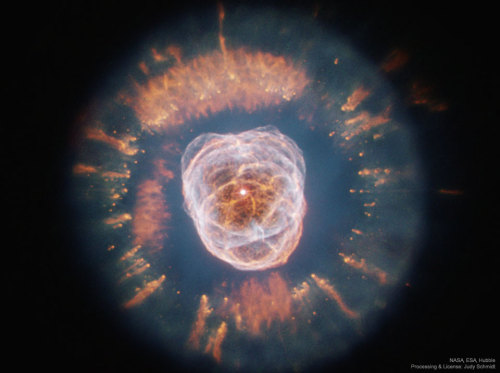
NGC 2392: Double Shelled Planetary Nebula #119 To some, this huge nebula resembles a person’s head surrounded by a parka hood. In 1787, astronomer William Herschel discovered this unusual planetary nebula: NGC 2392. More recently, the Hubble Space Telescope imaged the nebula in visible light, while the nebula was also imaged in X-rays by the Chandra X-ray Observatory. The featured combined visible-X ray image, shows X-rays emitted by central hot gas in pink. The nebula displays gas clouds so complex they are not fully understood. NGC 2392 is a double-shelled planetary nebula, with the more distant gas having composed the outer layers of a Sun-like star only 10,000 years ago. The outer shell contains unusual light-year long orange filaments. The inner filaments visible are being ejected by strong wind of particles from the central star. The NGC 2392 Nebula spans about 1/3 of a light year and lies in our Milky Way Galaxy, about 3,000 light years distant, toward the constellation of the Twins (Gemini). via NASA https://apod.nasa.gov/apod/ap200216.html


from WordPress https://vladislavkarelin.wordpress.com/2020/02/16/ngc-2392-double-shelled-planetary-nebula-119-to-some-this/


https://66.media.tumblr.com/f0ef2f8eb0a1dde7d3424b6c55db3846/2565a55839730648-80/s500x750/6987f921fb12ad19421cedfacab7178bef1495b2.jpg

20 января 2020 г.

Quadrantid Meteors through Orion #119 Why are these meteor…

Quadrantid Meteors through Orion #119 Why are these meteor trails nearly parallel? Because they were all shed by the same space rock and so can be traced back to the same direction on the sky: the radiant of the Quadrantid Meteor Shower. This direction used to be toward the old constellation of Quadrans Muralis, hence the name Quadrantids, but when the International Astronomical Union formulated its list of modern constellations in 1922, this constellation did not make the list. Even though the meteors are now considered to originate from the recognized constellation of Bootes, the old name stuck. Regardless of the designation, every January the Earth moves through a dust stream and bits of this dust glow as meteors as they heat up in Earth’s atmosphere. The featured image composite was taken on January 4 with a picturesque snowy Slovakian landscape in the foreground, and a deep-exposure sky prominently featuring the constellation Orion in the background. The red star Betelgeuse appears unusually dim – its fading over the past few months is being tracked by astronomers. via NASA https://apod.nasa.gov/apod/ap200120.html


from WordPress https://vladislavkarelin.wordpress.com/2020/01/20/quadrantid-meteors-through-orion-119-why-are-these-meteor/


https://66.media.tumblr.com/9ead19dc783412c8b1f9a642e3ef4e81/c766f81e3ebe9449-08/s500x750/cc673347a53a79c8d966b27060f27a48eb34da0a.jpg