20 января 2020 г.

Quadrantid Meteors through Orion #119 Why are these meteor…

Quadrantid Meteors through Orion #119 Why are these meteor trails nearly parallel? Because they were all shed by the same space rock and so can be traced back to the same direction on the sky: the radiant of the Quadrantid Meteor Shower. This direction used to be toward the old constellation of Quadrans Muralis, hence the name Quadrantids, but when the International Astronomical Union formulated its list of modern constellations in 1922, this constellation did not make the list. Even though the meteors are now considered to originate from the recognized constellation of Bootes, the old name stuck. Regardless of the designation, every January the Earth moves through a dust stream and bits of this dust glow as meteors as they heat up in Earth’s atmosphere. The featured image composite was taken on January 4 with a picturesque snowy Slovakian landscape in the foreground, and a deep-exposure sky prominently featuring the constellation Orion in the background. The red star Betelgeuse appears unusually dim – its fading over the past few months is being tracked by astronomers. via NASA https://apod.nasa.gov/apod/ap200120.html


from WordPress https://vladislavkarelin.wordpress.com/2020/01/20/quadrantid-meteors-through-orion-119-why-are-these-meteor/


https://66.media.tumblr.com/9ead19dc783412c8b1f9a642e3ef4e81/c766f81e3ebe9449-08/s500x750/cc673347a53a79c8d966b27060f27a48eb34da0a.jpg

2 декабря 2019 г.

Mercury Crosses a Quiet Sun #119 What’s that black dot…

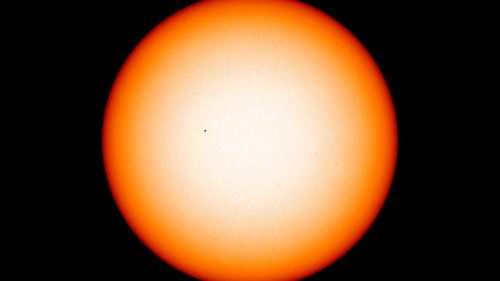
Mercury Crosses a Quiet Sun #119 What’s that black dot crossing the Sun? The planet Mercury. Mercury usually passes over or under the Sun, as seen from Earth, but last month the Solar System’s innermost planet appeared to go just about straight across the middle. Although witnessed by planet admirers across the globe, a particularly clear view was captured by the Solar Dynamics Observatory (SDO) in Earth orbit. The featured video was captured by the SDO’s HMI instrument in a broad range of visible light, and compresses the 5 ½ hour transit into about 13 seconds. The background Sun was unusually quiet – even for being near Solar Minimum – and showed no sunspots. The next solar transit by Mercury will occur in 2032. via NASA https://apod.nasa.gov/apod/ap191202.html


from WordPress https://vladislavkarelin.wordpress.com/2019/12/02/mercury-crosses-a-quiet-sun-119-whats-that-black-dot/


https://66.media.tumblr.com/5c6b3027ad25de37464b0482da78a127/52fa4b08066be350-62/s500x750/5c905258a71aa29aec007c6ad471ed80723a07cf.jpg

29 ноября 2019 г.

Galileo s Europa Remastered #119 Looping through the Jovian…

Galileo s Europa Remastered #119 Looping through the Jovian system in the late 1990s, the Galileo spacecraft recorded stunning views of Europa and uncovered evidence that the moon’s icy surface likely hides a deep, global ocean. Galileo’s Europa image data has been remastered here, using improved new calibrations to produce a color image approximating what the human eye might see. Europa’s long curving fractures hint at the subsurface liquid water. The tidal flexing the large moon experiences in its elliptical orbit around Jupiter supplies the energy to keep the ocean liquid. But more tantalizing is the possibility that even in the absence of sunlight that process could also supply the energy to support life, making Europa one of the best places to look for life beyond Earth. What kind of life could thrive in a deep, dark, subsurface ocean? Consider planet Earth’s own extreme shrimp. via NASA https://apod.nasa.gov/apod/ap191129.html


from WordPress https://vladislavkarelin.wordpress.com/2019/11/29/galileo-s-europa-remastered-119-looping-through-the-jovian/


https://66.media.tumblr.com/00c72a2eff83ed121eec0685a9cd8383/7bc677a7d976a17c-ee/s500x750/9ddd8387e4c8378d497ec9f60f13d16576d6c249.jpg

25 октября 2019 г.

The Ghosts of Cassiopeia #119 These bright rims and flowing…

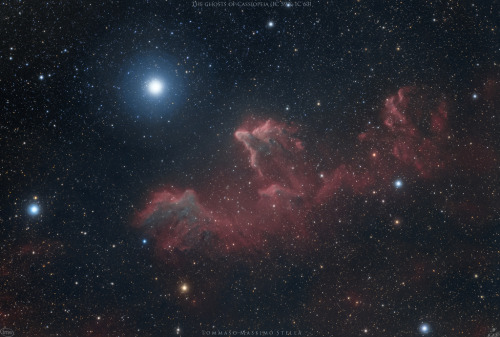
The Ghosts of Cassiopeia #119 These bright rims and flowing shapes look ghostly on a cosmic scale. A telescopic view toward the constellation Cassiopeia, the colorful skyscape features swept-back, comet-shaped clouds IC 59 (left) and IC 63. About 600 light-years distant, the clouds aren’t actually ghosts. They are slowly disappearing though, under the influence of energetic radiation from hot,luminous star gamma Cas. Gamma Cas is physically located only 3 to 4 light-years from the nebulae, the bright star just above and left in the frame. Slightly closer to gamma Cas, IC 63 is dominated by red H-alpha light emitted as hydrogen atoms ionized by the star’s ultraviolet radiation recombine with electrons. Farther from the star, IC 59 shows proportionally less H-alpha emission but more of the characteristic blue tint of dust reflected star light. The field of view spans over 1 degree or 10 light-years at the estimated distance of gamma Cas and friends. via NASA https://apod.nasa.gov/apod/ap191025.html


from WordPress https://vladislavkarelin.wordpress.com/2019/10/25/the-ghosts-of-cassiopeia-119-these-bright-rims-and-flowing/


https://66.media.tumblr.com/706189ef3f196169eb7c23b68e05ea4c/a581365a3e243928-7c/s500x750/24ff2676861493dbd6f91e2d664265a10f701273.jpg

5 сентября 2019 г.

The Large Cloud of Magellan #119 The 16th century Portuguese…

The Large Cloud of Magellan #119 The 16th century Portuguese navigator Ferdinand Magellan and his crew had plenty of time to study the southern sky during the first circumnavigation of planet Earth. As a result, two fuzzy cloud-like objects easily visible to southern hemisphere skygazers are known as the Clouds of Magellan, now understood to be satellite galaxies of our much larger, spiral Milky Way galaxy. About 160,000 light-years distant in the constellation Dorado, the Large Magellanic Cloud (LMC) is seen here in a remarkably deep, colorful, image. Spanning about 15,000 light-years or so, it is the most massive of the Milky Way’s satellite galaxies and is the home of the closest supernova in modern times, SN 1987A. The prominent patch below center is 30 Doradus, also known as the magnificent Tarantula Nebula, a giant star-forming region about 1,000 light-years across. via NASA https://apod.nasa.gov/apod/ap190905.html


from WordPress https://vladislavkarelin.wordpress.com/2019/09/05/the-large-cloud-of-magellan-119-the-16th-century-portuguese/


https://66.media.tumblr.com/0bc73e81f6092cd1254c1de52a0e761a/tumblr_pxcdup65ae1xorz76o1_500.jpg