10 марта 2020 г.

Wide Field: Fox Fur, Unicorn, and Christmas Tree #119 What do…

Wide Field: Fox Fur, Unicorn, and Christmas Tree #119 What do the following things have in common: a cone, the fur of a fox, and a Christmas tree? Answer: they all occur in the constellation of the unicorn (Monoceros). Pictured as a star forming region and cataloged as NGC 2264, the complex jumble of cosmic gas and dust is about 2,700 light-years distant and mixes reddish emission nebulae excited by energetic light from newborn stars with dark interstellar dust clouds. Where the otherwise obscuring dust clouds lie close to the hot, young stars they also reflect starlight, forming blue reflection nebulae. The featured wide-field image spans over three times the diameter of a full moon, covering over 100 light-years at the distance of NGC 2264. Its cast of cosmic characters includes the Fox Fur Nebula, whose convoluted pelt lies just to the lower right of the image center, bright variable star S Mon visible just above the Fox Fur, and the Cone Nebula just to the left. Given their distribution, the stars of NGC 2264 are also known as the Christmas Tree star cluster. via NASA https://apod.nasa.gov/apod/ap200310.html


from WordPress https://vladislavkarelin.wordpress.com/2020/03/10/wide-field-fox-fur-unicorn-and-christmas-tree-119-what-do/


https://66.media.tumblr.com/13543293da65dc1de7588eafd2fa07b5/62a3a4db85a46ff7-fb/s500x750/85c9449f2bfaaf138309534130d1c932f2321e6c.jpg

9 марта 2020 г.

Milky Way and Zodiacal Light over Chile #119 What is the band…

Milky Way and Zodiacal Light over Chile #119 What is the band of light connecting the ground to the Milky Way? Zodiacal light – a stream of dust that orbits the Sun in the inner Solar System. It is most easily seen just before sunrise, where it has been called a false dawn, or just after sunset. The origin of zodiacal dust remains a topic of research, but is hypothesized to result from asteroid collisions and comet tails. The featured wide-angle image shows the central band of our Milky Way Galaxy arching across the top, while the Large Magellanic Cloud (LMC), a satellite galaxy to our Milky Way, is visible on the far left. The image is a combination of over 30 exposures taken last July near La Serena among the mountains of Chile. During the next two months, zodiacal light can appear quite prominent in northern skies just after sunset. via NASA https://apod.nasa.gov/apod/ap200309.html


from WordPress https://vladislavkarelin.wordpress.com/2020/03/09/milky-way-and-zodiacal-light-over-chile-119-what-is-the-band/


https://66.media.tumblr.com/9c5a43c446fd8fd676f127d074020893/b9a7fc4ee0949ba3-f4/s500x750/8baea08304a94e6e008aa9b7701f5e805472b594.jpg

8 марта 2020 г.

Wolf Rayet Star 124: Stellar Wind Machine #119 Some stars…

Wolf Rayet Star 124: Stellar Wind Machine #119 Some stars explode in slow motion. Rare, massive Wolf-Rayet stars are so tumultuous and hot that they are slowly disintegrating right before our telescopes. Glowing gas globs each typically over 30 times more massive than the Earth are being expelled by violent stellar winds. Wolf-Rayet star WR 124, visible near the featured image center spanning six light years across, is thus creating the surrounding nebula known as M1-67. Details of why this star has been slowly blowing itself apart over the past 20,000 years remains a topic of research. WR 124 lies 15,000 light-years away towards the constellation of the Arrow (Sagitta). The fate of any given Wolf-Rayet star likely depends on how massive it is, but many are thought to end their lives with spectacular explosions such as supernovas or gamma-ray bursts. via NASA https://apod.nasa.gov/apod/ap200308.html


from WordPress https://vladislavkarelin.wordpress.com/2020/03/08/wolf-rayet-star-124-stellar-wind-machine-119-some-stars/


https://66.media.tumblr.com/601b9e47dd9f8583fdf275d5c4d002a4/943515dcfd42b31b-f8/s500x750/5fc43a2c6e94d5a37ea82021bacf49e869f71961.jpg

16 февраля 2020 г.

NGC 2392: Double Shelled Planetary Nebula #119 To some, this…

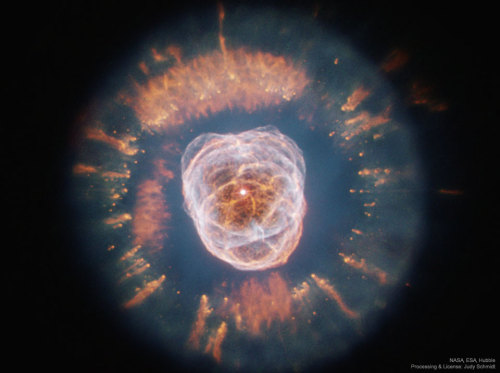
NGC 2392: Double Shelled Planetary Nebula #119 To some, this huge nebula resembles a person’s head surrounded by a parka hood. In 1787, astronomer William Herschel discovered this unusual planetary nebula: NGC 2392. More recently, the Hubble Space Telescope imaged the nebula in visible light, while the nebula was also imaged in X-rays by the Chandra X-ray Observatory. The featured combined visible-X ray image, shows X-rays emitted by central hot gas in pink. The nebula displays gas clouds so complex they are not fully understood. NGC 2392 is a double-shelled planetary nebula, with the more distant gas having composed the outer layers of a Sun-like star only 10,000 years ago. The outer shell contains unusual light-year long orange filaments. The inner filaments visible are being ejected by strong wind of particles from the central star. The NGC 2392 Nebula spans about 1/3 of a light year and lies in our Milky Way Galaxy, about 3,000 light years distant, toward the constellation of the Twins (Gemini). via NASA https://apod.nasa.gov/apod/ap200216.html


from WordPress https://vladislavkarelin.wordpress.com/2020/02/16/ngc-2392-double-shelled-planetary-nebula-119-to-some-this/


https://66.media.tumblr.com/f0ef2f8eb0a1dde7d3424b6c55db3846/2565a55839730648-80/s500x750/6987f921fb12ad19421cedfacab7178bef1495b2.jpg

20 января 2020 г.

Quadrantid Meteors through Orion #119 Why are these meteor…

Quadrantid Meteors through Orion #119 Why are these meteor trails nearly parallel? Because they were all shed by the same space rock and so can be traced back to the same direction on the sky: the radiant of the Quadrantid Meteor Shower. This direction used to be toward the old constellation of Quadrans Muralis, hence the name Quadrantids, but when the International Astronomical Union formulated its list of modern constellations in 1922, this constellation did not make the list. Even though the meteors are now considered to originate from the recognized constellation of Bootes, the old name stuck. Regardless of the designation, every January the Earth moves through a dust stream and bits of this dust glow as meteors as they heat up in Earth’s atmosphere. The featured image composite was taken on January 4 with a picturesque snowy Slovakian landscape in the foreground, and a deep-exposure sky prominently featuring the constellation Orion in the background. The red star Betelgeuse appears unusually dim – its fading over the past few months is being tracked by astronomers. via NASA https://apod.nasa.gov/apod/ap200120.html


from WordPress https://vladislavkarelin.wordpress.com/2020/01/20/quadrantid-meteors-through-orion-119-why-are-these-meteor/


https://66.media.tumblr.com/9ead19dc783412c8b1f9a642e3ef4e81/c766f81e3ebe9449-08/s500x750/cc673347a53a79c8d966b27060f27a48eb34da0a.jpg