29 января 2019 г.

Ultima Thule from New Horizons #119 How do distant asteroids…

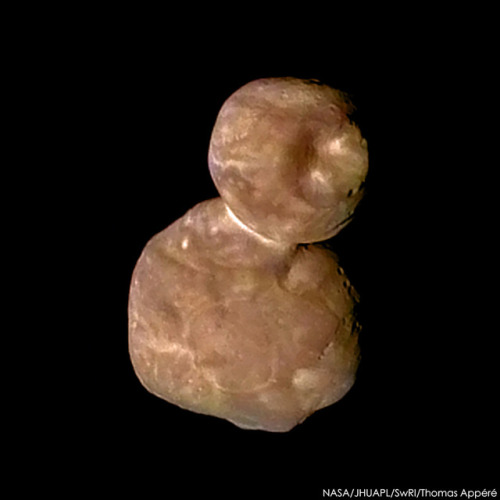
Ultima Thule from New Horizons #119 How do distant asteroids differ from those near the Sun? To help find out, NASA sent the robotic New Horizons spacecraft past the classical Kuiper belt object 2014 MU69, nicknamed Ultima Thule, the farthest asteroid yet visited by a human spacecraft. Zooming past the 30-km long space rock on January 1, the featured image is the highest resolution picture of Ultima Thule’s surface beamed back so far. Utima Thuli does look different than imaged asteroids of the inner Solar System, as it shows unusual surface texture, relatively few obvious craters, and nearly spherical lobes. Its shape is hypothesized to have formed from the coalescence of early Solar System rubble in into two objects – Ultima and Thule – which then spiraled together and stuck. Research will continue into understanding the origin of different surface regions on Ultima Thule, whether it has a thin atmosphere, how it obtained its red color, and what this new knowledge of the ancient Solar System tells us about the formation of our Earth. via NASA https://apod.nasa.gov/apod/ap190129.html


from WordPress https://vladislavkarelin.wordpress.com/2019/01/29/ultima-thule-from-new-horizons-119-how-do-distant-asteroids/


https://66.media.tumblr.com/84cf7272773ccec24f07a5edb84b2bf1/tumblr_pm2wkxWUJ91xorz76o1_500.jpg

4 января 2019 г.

#119 Ultima Thule is the most distant world explored by a…

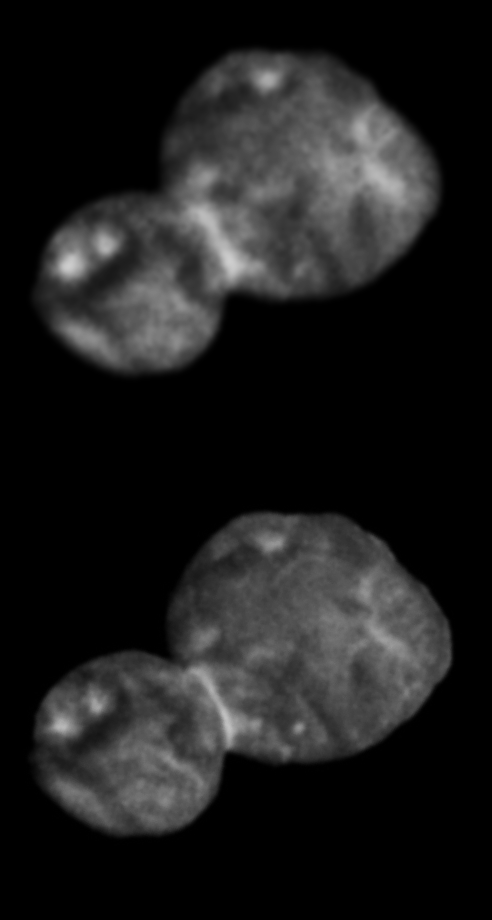
#119 Ultima Thule is the most distant world explored by a spacecraft from Earth. In the dim light 6.5 billion kilometers from the Sun, the New Horizons spacecraft captured these two frames 38 minutes apart as it sped toward the Kuiper belt world on January 1 at 51,000 kilometers per hour. A contact binary, the two lobes of Ultima Thule rotate together once every 15 hours or so. Shown as a blinking gif, the rotation between the frames produces a tantalizing 3D perspective of the most primitive world ever seen. Dubbed separately by the science team Ultima and Thule, the larger lobe Ultima, is about 19 kilometers in diameter. Smaller Thule is 14 kilometers across. via NASA https://apod.nasa.gov/apod/ap190104.html


from WordPress https://vladislavkarelin.wordpress.com/2019/01/04/119-ultima-thule-is-the-most-distant-world-explored-by-a/


https://66.media.tumblr.com/8f8dbfe2f982773c8a8359c98000e062/tumblr_pkslsxP2Qk1xorz76o1_500.gif

1 января 2019 г.

The Sombrero Galaxy in Infrared #119 This floating ring is the…

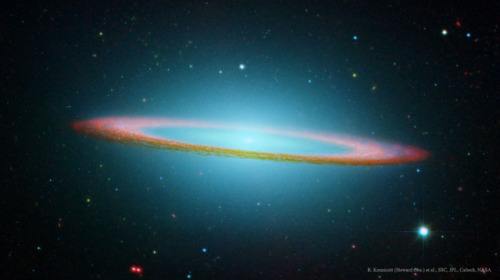
The Sombrero Galaxy in Infrared #119 This floating ring is the size of a galaxy. In fact, it is a galaxy – or at least part of one: the photogenic Sombrero Galaxy, one of the largest galaxies in the nearby Virgo Cluster of Galaxies. The dark band of dust that obscures the mid-section of the Sombrero Galaxy in optical light actually glows brightly in infrared light. The featured image, digitally sharpened, shows the infrared glow, recently recorded by the orbiting Spitzer Space Telescope, superposed in false-color on an existing image taken by NASA’s Hubble Space Telescope in optical light. The Sombrero Galaxy, also known as M104, spans about 50,000 light years across and lies 28 million light years away. M104 can be seen with a small telescope in the direction of the constellation Virgo. via NASA https://apod.nasa.gov/apod/ap190101.html


from WordPress https://vladislavkarelin.wordpress.com/2019/01/01/the-sombrero-galaxy-in-infrared-119-this-floating-ring-is-the/


https://66.media.tumblr.com/8eeca4e0df8731bf23a18f9994da0831/tumblr_pkn1shLkTl1xorz76o1_500.jpg

25 декабря 2018 г.

M100: A Grand Design Spiral Galaxy #119 Majestic on a truly…

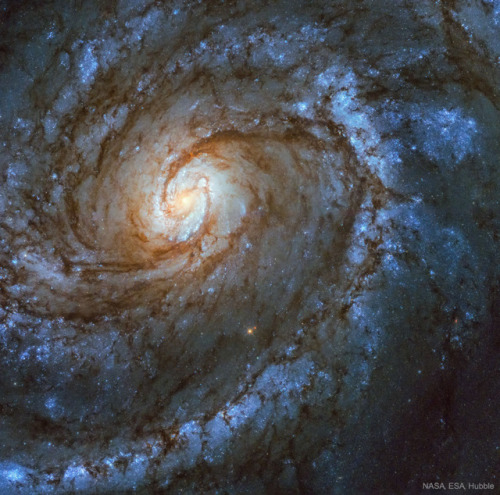
M100: A Grand Design Spiral Galaxy #119 Majestic on a truly cosmic scale, M100 is appropriately known as a grand design spiral galaxy. It is a large galaxy of over 100 billion stars with well-defined spiral arms that is similar to our own Milky Way Galaxy. One of the brightest members of the Virgo Cluster of galaxies, M100 (alias NGC 4321) is 56 million light-years distant toward the constellation of Berenice’s Hair (Coma Berenices). This Hubble Space Telescope image of M100 was taken recently with the Wide Field Camera 3 and accentuates bright blue star clusters and intricate winding dust lanes which are hallmarks of this class of galaxies. Studies of variable stars in M100 have played an important role in determining the size and age of the Universe. via NASA https://apod.nasa.gov/apod/ap181225.html


from WordPress https://vladislavkarelin.wordpress.com/2018/12/25/m100-a-grand-design-spiral-galaxy-119-majestic-on-a-truly/


https://66.media.tumblr.com/44b2a1a2e5a9696c4abbf6500dfadbb4/tumblr_pka34aIgF01xorz76o1_500.jpg

12 декабря 2018 г.

M43: Orion Falls #119 Is there a waterfall in Orion? No, but…

M43: Orion Falls #119 Is there a waterfall in Orion? No, but some of the dust in M43 appears similar to a waterfall on Earth. M43, part of the Orion Molecular Cloud Complex, is the often imaged but rarely mentioned neighbor of the more famous M42. M42, which includes many bright stars from the Trapezium cluster, lies above the featured scene. M43 is itself a star forming region and although laced with filaments of dark dust, is composed mostly of glowing hydrogen. The entire Orion field, located about 1600 light years away, is inundated with many intricate and picturesque filaments of dust. Opaque to visible light, dark dust is created in the outer atmosphere of massive cool stars and expelled by a strong outer wind of protons and electrons. via NASA https://apod.nasa.gov/apod/ap181212.html


from WordPress https://vladislavkarelin.wordpress.com/2018/12/12/m43-orion-falls-119-is-there-a-waterfall-in-orion-no-but/


https://66.media.tumblr.com/7702add78c96a3ca63bad689f7b7de6b/tumblr_pjm0gq0KnR1xorz76o1_500.jpg