21 апреля 2020 г.

Eye on the Milky Way #119 Have you ever had stars in your…

Eye on the Milky Way #119 Have you ever had stars in your eyes? It appears that the eye on the left does, and moreover it appears to be gazing at even more stars. The featured 27-frame mosaic was taken last July from Ojas de Salar in the Atacama Desert of Chile. The eye is actually a small lagoon captured reflecting the dark night sky as the Milky Way Galaxy arched overhead. The seemingly smooth band of the Milky Way is really composed of billions of stars, but decorated with filaments of light-absorbing dust and red-glowing nebulas. Additionally, both Jupiter (slightly left the galactic arch) and Saturn (slightly to the right) are visible. The lights of small towns dot the unusual vertical horizon. The rocky terrain around the lagoon appears to some more like the surface of Mars than our Earth. via NASA https://apod.nasa.gov/apod/ap200421.html


from WordPress https://vladislavkarelin.wordpress.com/2020/04/21/eye-on-the-milky-way-119-have-you-ever-had-stars-in-your/


https://66.media.tumblr.com/9dbfe238fa55ab8307dfec066fd683e9/6b508d89f34cdcd1-79/s500x750/d9da8b1e25b8c8dc94d72df68660d61923d87840.jpg

20 апреля 2020 г.

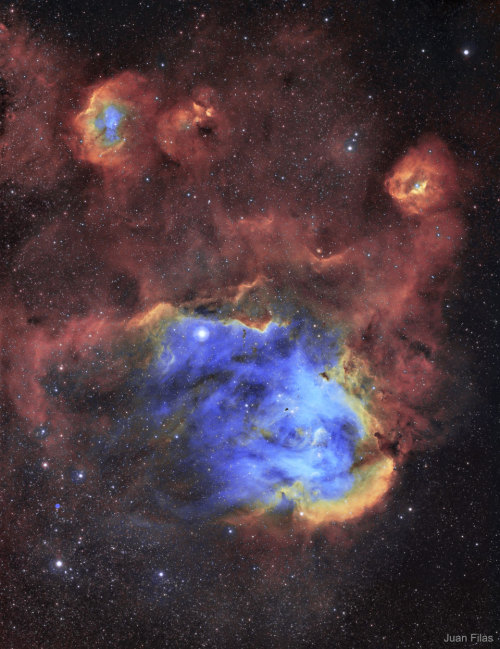
IC 2944: The Running Chicken Nebula #119 To some, it looks…

IC 2944: The Running Chicken Nebula #119 To some, it looks like a giant chicken running across the sky. To others, it looks like a gaseous nebula where star formation takes place. Cataloged as IC 2944, the Running Chicken Nebula spans about 100 light years and lies about 6,000 light years away toward the constellation of the Centaur (Centaurus). The featured image, shown in scientifically assigned colors, was captured recently in a 12-hour exposure. The star cluster Collinder 249 is visible embedded in the nebula’s glowing gas. Although difficult to discern here, several dark molecular clouds with distinct shapes can be found inside the nebula. via NASA https://apod.nasa.gov/apod/ap200420.html


from WordPress https://vladislavkarelin.wordpress.com/2020/04/20/ic-2944-the-running-chicken-nebula-119-to-some-it-looks/


https://66.media.tumblr.com/e49d2539483f575791ee0128f8ce816e/5010f7aee5a23e53-7a/s500x750/c94d5396778134bb4277fa4409b3dbf638d0e326.jpg

14 апреля 2020 г.

NGC 253: The Silver Coin Galaxy #119 NGC 253 is one of the…

NGC 253: The Silver Coin Galaxy #119 NGC 253 is one of the brightest spiral galaxies visible, but also one of the dustiest. Dubbed the Silver Coin for its appearance in smalltelescopes, it is more formally known as the Sculptor Galaxy for its location within the boundaries of the southern constellation Sculptor. Discovered in 1783 by mathematician and astronomer Caroline Herschel, the dusty island universe lies a mere 10 million light-years away. About 70 thousand light-years across, NGC 253, pictured, is the largest member of the Sculptor Group of Galaxies, the nearest to our own Local Group of galaxies. In addition to its spiral dust lanes, tendrils of dust seem to be rising from a galactic disk laced with young star clusters and star forming regions in this sharp color image. The high dust content accompanies frantic star formation, earning NGC 253 the designation of a starburst galaxy. NGC 253 is also known to be a strong source of high-energy x-rays and gamma rays, likely due to massive black holes near the galaxy’s center. Take a trip through extragalactic space in this short video flyby of NGC 253. via NASA https://apod.nasa.gov/apod/ap200414.html


from WordPress https://vladislavkarelin.wordpress.com/2020/04/14/ngc-253-the-silver-coin-galaxy-119-ngc-253-is-one-of-the/


https://66.media.tumblr.com/fd073b917a205604bb7c17a027f41b8b/b64626e6100503fc-df/s500x750/67eb26ffd60145399094bf13b19389eed225cc1e.jpg

#43ap Wikipedia picture of the day on April 14, 2020: View of a…

#43ap Wikipedia picture of the day on April 14, 2020:
View of a lake in the Eagle River Valley, Municipality of Anchorage, Alaska, United States.
Parque Eagle River, Anchorage, Alaska, Estados Unidos, 2017-09-01, DD 02.jpg.


from WordPress https://vladislavkarelin.wordpress.com/2020/04/14/43ap-wikipedia-picture-of-the-day-on-april-14-2020-view-of-a/


https://66.media.tumblr.com/83a03a373f4b978cf945816e612c43b7/f612cb779d71ba34-21/s500x750/5e7cb967f92ec5192e53e3b25a07a3794c4fc91e.jpg

13 апреля 2020 г.

A Sailing Stone across Death Valley #119 How did this big rock…

A Sailing Stone across Death Valley #119 How did this big rock end up on this strange terrain? One of the more unusual places here on Earth occurs inside Death Valley, California, USA. There a dried lakebed named Racetrack Playa exists that is almost perfectly flat, with the odd exception of some very large stones, one of which is pictured here in April of 2019 beneath a dark, Milky-Way filled sky. Now the flatness and texture of large playa like Racetrack are fascinating but not scientifically puzzling – they are caused by mud flowing, drying, and cracking after a heavy rain. Only recently, however, has a viable scientific hypothesis been given to explain how heavy sailing stones end up near the middle of such a large flat surface. Unfortunately, as frequently happens in science, a seemingly surreal problem ends up having a relatively mundane solution. It turns out that in winter thin ice sheets form, and winds push ice sections laden with even heavy rocks across the temporarily slick playa when sunlight melts the ice. via NASA https://apod.nasa.gov/apod/ap200413.html


from WordPress https://vladislavkarelin.wordpress.com/2020/04/13/a-sailing-stone-across-death-valley-119-how-did-this-big-rock/


https://66.media.tumblr.com/c98e4d57da45afb8551afc97dfc3651d/cbc4a51ce10d0056-ca/s500x750/6e673c3c9d3ab8ebd79aafb1be35634638af331d.jpg